TL;DR: Keyword frequency shows what competitors emphasize, but placement, relevance, and buyer intent decide whether you should copy it.
Key Takeaways
- Frequency signals market emphasis, but placement determines its strategic weight.
- Analyze 5‑10 competitor listings across title, bullets, A+, images, and reviews for a complete picture.
- Combine frequency insights with reverse‑ASIN data to prioritize high‑impact, relevant keywords.
Table of Contents
- What Keyword Frequency Really Means in Amazon Competitor Listings
- Why Sellers Should Analyze Competitor Keyword Frequency
- The Wrong Way to Read Keyword Frequency
- The 5 Layers of Competitor Keyword Frequency Analysis
- Frequency Is Not Enough: Add Placement Weight
- Competitor Keyword Frequency Patterns That Reveal Strategy
- How to Analyze Keyword Frequency Without Creating Robotic Copy
- Keyword Frequency vs. Keyword Relevance: The Critical Distinction
- Turning Competitor Frequency Insights Into Listing Optimization
- A Better Metric: Keyword Theme Saturation
- Mini Case Example: From Competitor Frequency to Better Copy
- Common Mistakes When Analyzing Competitor Keyword Frequency
- FAQ
- References
Note on marketplaces: This guide is specifically optimized for the US market.
What Keyword Frequency Really Means in Amazon Competitor Listings
Understanding a competitor's keyword frequency is the first step toward a data‑driven listing strategy. It tells you which concepts sellers repeatedly spotlight across their copy.
Frequency vs. Density vs. Placement
Frequency counts occurrences, density expresses them as a percentage of total words, and placement identifies where they live (title, bullet, image, etc.). Sellers often confuse these three, leading to misguided copy.
Why Frequency Still Matters
Repeating a term across multiple sections signals that the market expects that concept. However, it's no longer a simple "repeat it more" shortcut.
The Modern View
Today, frequency is a strategic emphasis indicator. If top competitors embed a keyword in title, bullets, A+, and backend fields, they're flagging a high‑buyer‑interest term, which is not just a SEO trick.
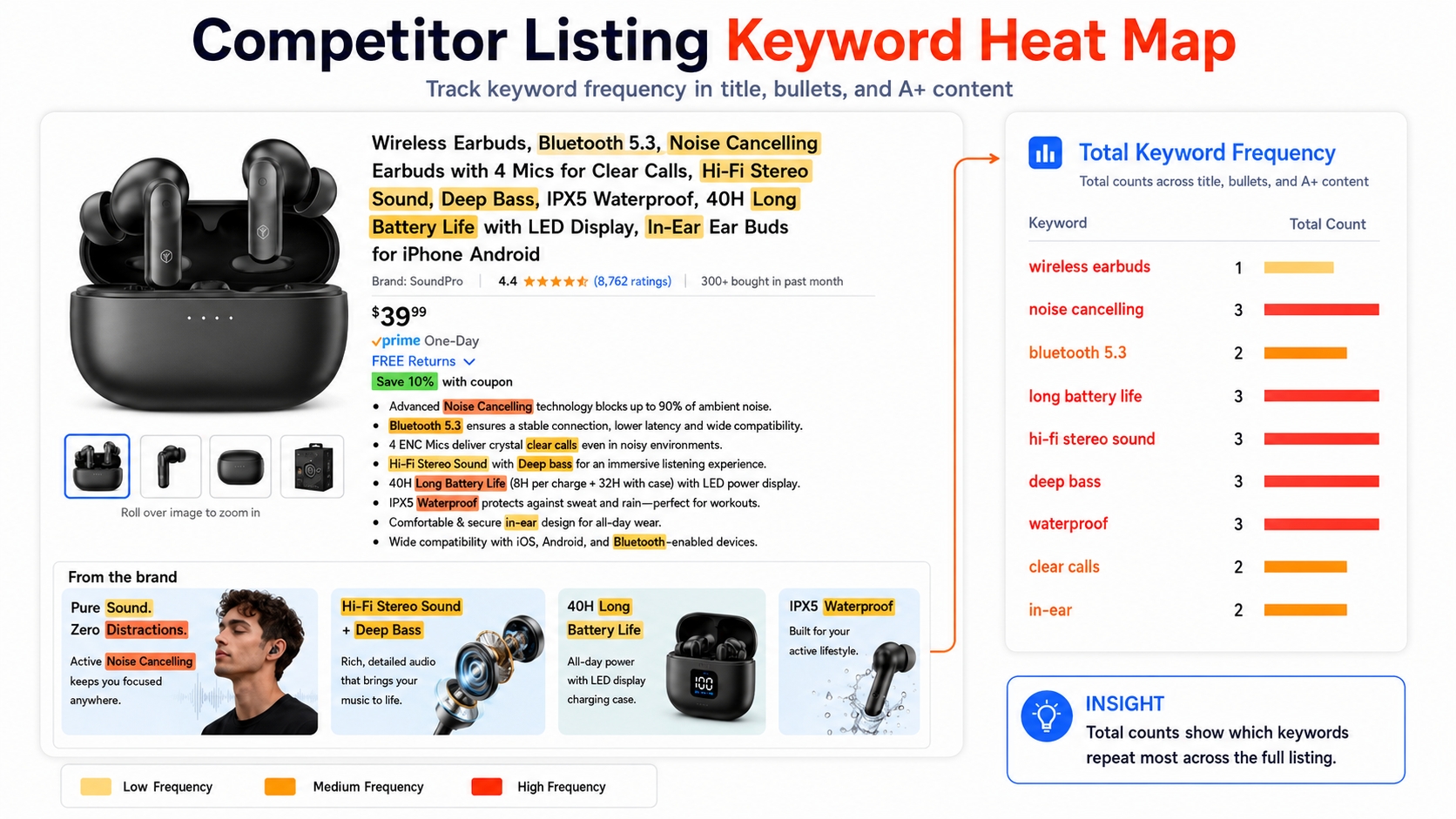
Why Sellers Should Analyze Competitor Keyword Frequency
It reveals what competitors believe shoppers care about
When several brands repeatedly tout "waterproof," they're confirming a category demand.
It shows which attributes dominate the category conversation
Attributes like "lightweight" or "eco‑friendly" appear prominently in bullet points, indicating persuasive levers.
It helps separate core demand language from decorative copy
A phrase repeatedly used in titles is a core keyword; a phrase only in marketing blurbs may be fluff.
It exposes positioning patterns competitors use repeatedly
If "gift‑ready" appears only in bullet #3, competitors treat it as a seasonal angle rather than a primary product trait.
Example: "waterproof" appears everywhere – a category requirement
Example: "travel" appears only in bullets – a secondary use case
Example: "gift" appears seasonally – a campaign angle
For a deeper dive on reverse‑ASIN research, try our Keyword Reverse ASIN Tool.
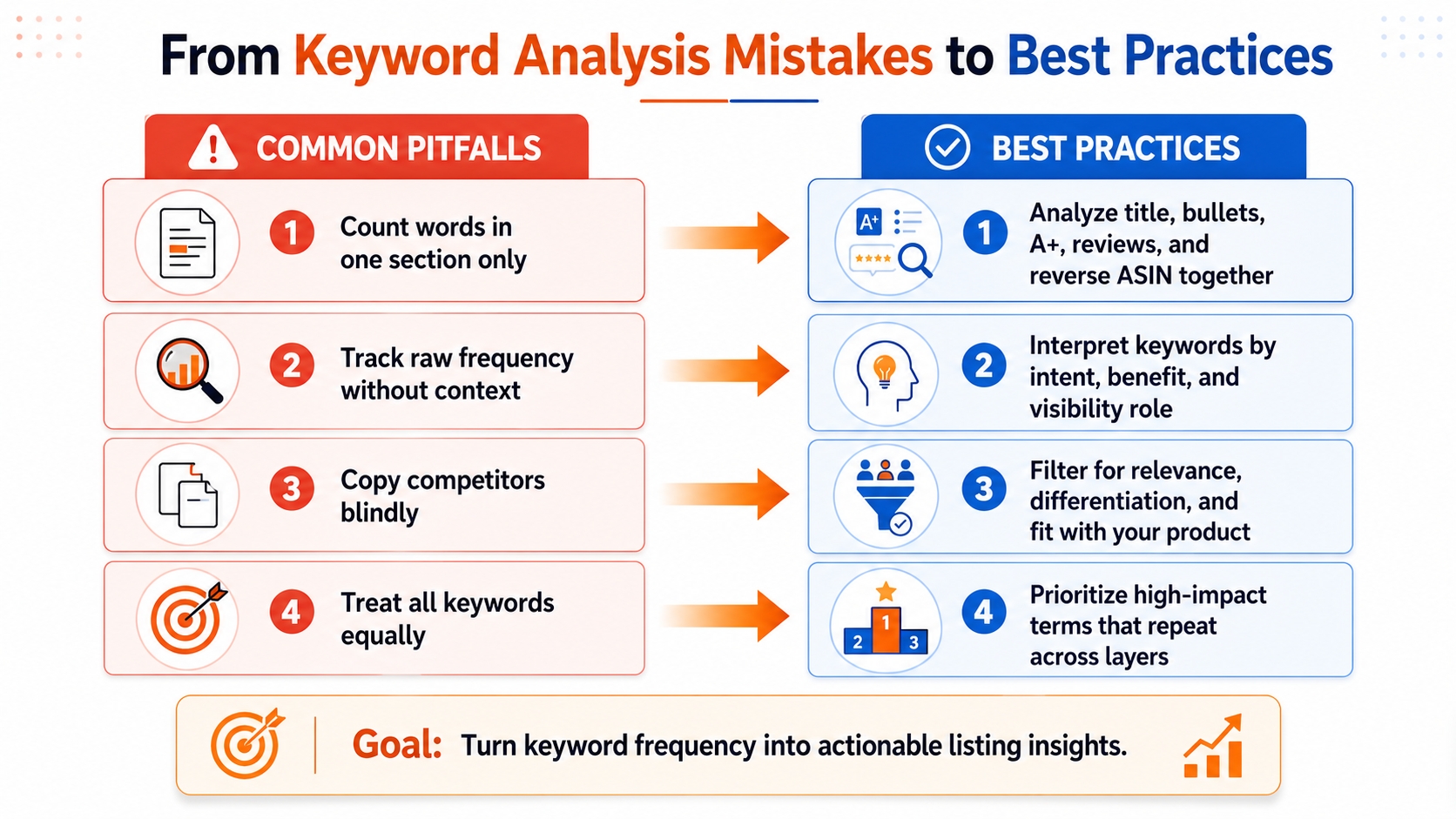
The Wrong Way to Read Keyword Frequency
Mistake 1: assuming more repetitions = better ranking
Amazon's algorithm weighs relevance and conversion, not raw repetition counts.
Mistake 2: copying competitor keyword repetition without understanding intent
Blindly mimicking a phrase can create a mismatch between copy and actual product features.
Mistake 3: counting words but ignoring where they appear
A keyword in the title carries more weight than the same word buried in an image caption.
Mistake 4: treating every repeated keyword as equally valuable
Some terms are conversion boosters (e.g., "certified"), while others are generic filler.
Myth: "If a competitor repeats a keyword five times, I should repeat it five times."
Fact: Frequency shows emphasis, but placement, relevance, and conversion context matter more.
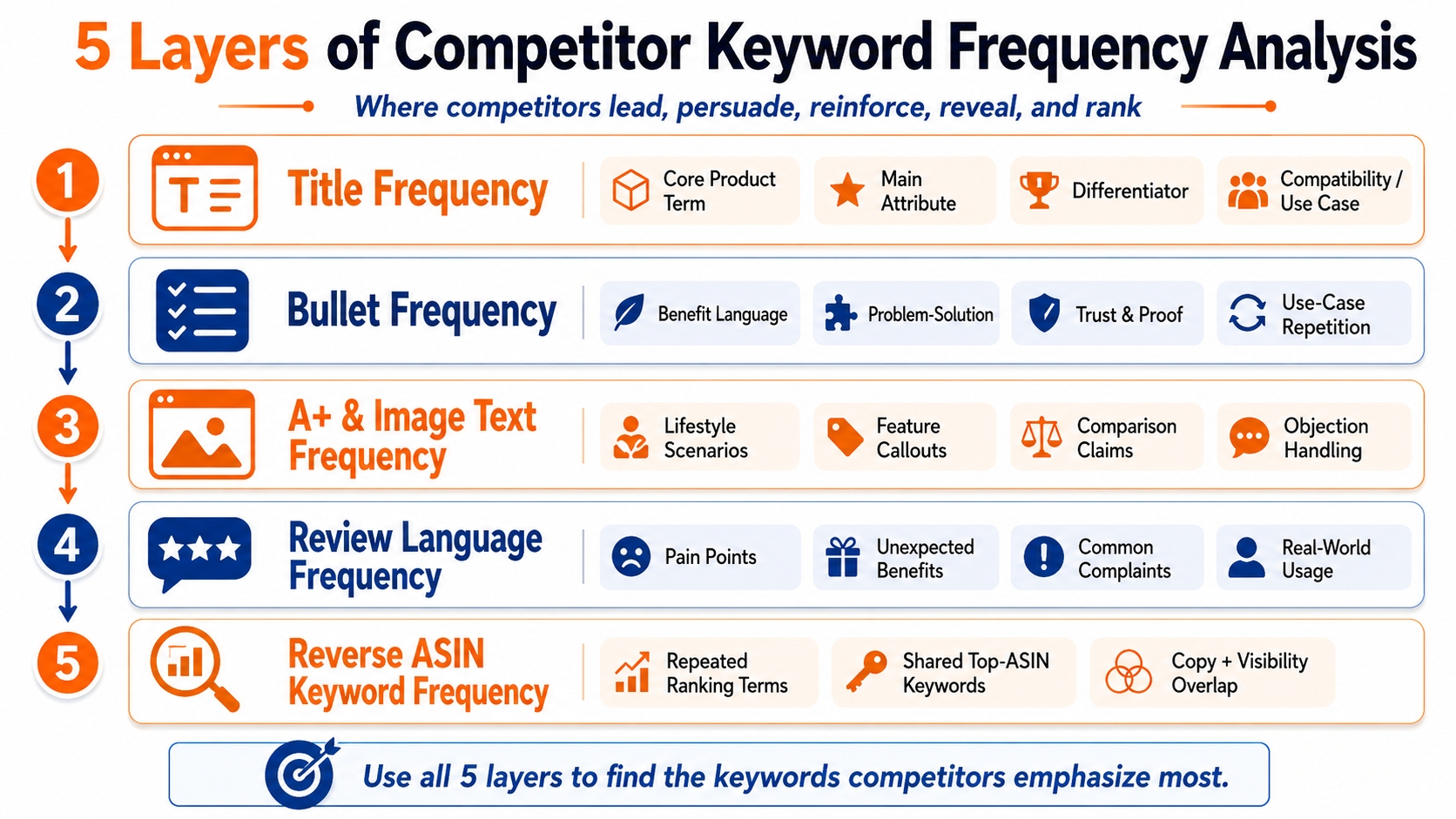
The 5 Layers of Competitor Keyword Frequency Analysis
Layer 1 – Title frequency: what competitors lead with
- Core product term
- Main attribute
- Differentiator
- Compatibility or use case
Layer 2 – Bullet frequency: what competitors use to persuade
- Benefit language
- Problem‑solution keywords
- Trust and proof terms
- Use‑case repetition
Layer 3 – A+ and image text frequency: what competitors visually reinforce
- Lifestyle scenarios
- Feature callouts
- Comparison claims
- Objection‑handling phrases
Layer 4 – Review language frequency: what buyers repeat naturally
- Pain points
- Unexpected benefits
- Common complaints
- Real‑world usage phrases
Layer 5 – Reverse ASIN keyword frequency: what the market rewards
- Keywords competitors rank for repeatedly
- Keywords shared by multiple top ASINs
- Keywords that appear in both listing copy and visibility data
Frequency Is Not Enough: Add Placement Weight
Why placement changes the meaning of frequency
A keyword in the title acts as a product identifier, while the same word in a review shows authentic buyer language.
A title keyword signals identity
If "waterproof backpack" appears in the title, shoppers immediately know the core promise.
A bullet keyword signals persuasion
Bullets turn features into benefits – e.g., "waterproof" + "protects electronics".
An image/A+ keyword signals positioning
Visuals reinforce the high‑priority message (e.g., a graphic showing "rain‑proof zipper").
A review keyword signals real customer language
If buyers repeatedly say "lightweight," that phrase carries strong social proof.
Placement‑Weighted Frequency Matrix
| Frequency | Placement Strength | Meaning |
|---|---|---|
| High | High | Core keyword theme |
| High | Low | Supporting or commodity term |
| Low | High | Differentiation angle |
| Low | Buyer reviews | Emerging opportunity |
Competitor Keyword Frequency Patterns That Reveal Strategy
The "category anchor" pattern
The same core product term appears across nearly every competitor title, signalling a non‑negotiable category attribute.
The "feature arms race" pattern
Competitors repeat an attribute (e.g., "silicone grip") because it drives click‑through and perceived quality.
The "use‑case specialization" pattern
One brand owns a niche scenario (e.g., "travel" for backpacks) and highlights it heavily in bullets.
The "trust language" pattern
Frequent terms like "certified", "durable", "warranty" signal risk reduction.
The "seasonal overlay" pattern
Keywords such as "gift", "holiday", or "summer" spike during specific campaigns.
How to Analyze Keyword Frequency Without Creating Robotic Copy
Start with a competitor set, not one competitor
Select 5-10 ASINs that share product type, price band, and buyer intent to avoid outliers.
Separate repeated words from repeated ideas
Group synonyms (e.g., "waterproof", "water resistant", "rain‑proof") as one concept.
Build keyword themes instead of raw word counts
Identify themes such as Core identity, Attribute, Use case, Compatibility, Problem‑solution, Trust/proof.
Compare competitor copy against visibility data
Use SellerSprite's reverse ASIN keyword research to confirm whether a high‑frequency term also drives traffic.
Decide what to copy, what to adapt, and what to avoid
- Copy the buyer intent that matches your product.
- Adapt the messaging to reflect your unique value.
- Avoid cloning exact wording that could sound generic.
Keyword Frequency vs. Keyword Relevance: The Critical Distinction
A repeated keyword can still be irrelevant to your offer
If your backpack isn't waterproof, emphasizing "waterproof" misleads shoppers.
A low‑frequency keyword can be highly relevant and profitable
Niche terms like "ski‑compatible" may attract a high‑intent audience even if few competitors use them.
Relevance protects conversion rate
Accurate keywords keep bounce rates low and increase sales velocity.
Conversion rate protects ranking momentum
Higher conversion feeds Amazon's A10 algorithm, reinforcing organic visibility.
Example: "heavy duty" is valuable only if your product can support that promise
Example: "travel size" is dangerous if your product is not actually portable
Example: "compatible with" terms should only be used when accurate
If the keyword is frequent but not truthful, do not use it. If it is less frequent but perfectly matches your product, test it.
Turning Competitor Frequency Insights Into Listing Optimization
Title: choose the strongest identity keyword, not every repeated keyword
Combine the primary product term with the most compelling differentiator and a top attribute.
Bullets: convert repeated themes into benefit‑driven messages
Allocate each high‑frequency theme to a single bullet and pair it with a tangible buyer outcome.
Backend search terms: place relevant variants, not repeated front‑end terms
- Synonyms
- Common misspellings
- Spacing variants
- Secondary long‑tails
A+ and images: visually reinforce high‑frequency objections and use cases
- Durability proof graphics
- Size clarification diagrams
- Compatibility charts
- Material quality close‑ups
A Better Metric: Keyword Theme Saturation
Why individual keyword frequency can mislead
A single word count ignores the broader conversation across the category.
What "theme saturation" means
It measures how many competitors mention the same underlying concept, regardless of exact wording.
How to measure it manually
- List the top 10 competitors.
- Group synonyms into a single theme.
- Count how many listings reference that theme.
How to use saturation strategically
- High saturation = category expectation – secure this baseline.
- Medium saturation = growth angle – test new variations.
- Low saturation + strong buyer reviews = differentiation opportunity.
Mini Case Example: From Competitor Frequency to Better Copy
Product category setup
Example product: Outdoor waterproof backpack (30 L).
Competitor frequency findings
- Core term appears in 8/10 titles.
- "Waterproof" theme appears in 6/10 listings.
- "Travel" appears in 3/10 listings but shows up frequently in reviews.
- "Gift" appears only during seasonal campaigns.
Interpretation
- Core term = must‑have identity keyword.
- Waterproof = expected category feature.
- Travel = differentiation opportunity.
- Gift = seasonal PPC/listing angle.
Final listing action
- Title: "Waterproof Outdoor Backpack – 30 L Durable Travel Gear"
- Bullet 1: Emphasize durability and waterproof protection.
- Bullet 2: Highlight travel‑friendly compartments.
- Backend: Add synonyms like "rain‑proof", "hiking", "camping".
- PPC: Test long‑tails such as "travel backpack waterproof".
Common Mistakes When Analyzing Competitor Keyword Frequency
- Counting keywords without judging intent
- Over‑copying competitors and losing differentiation
- Treating competitor frequency as Amazon's official ranking formula
- Ignoring customer review language
- Using frequent keywords that increase traffic but lower conversion
- Updating copy without measuring before/after performance
FAQ
How does keyword frequency affect product ranking on Amazon?
Frequency itself isn't a direct ranking factor, but high‑frequency terms signal market emphasis. When those terms appear in high‑placement spots (title, bullets) and also drive clicks, they indirectly boost visibility.
What is the ideal keyword density for Amazon product titles and descriptions?
Amazon doesn't publish a strict density rule. Aim for 1‑2 core keywords in the title and keep the rest of the copy natural. Over‑stuffing (>3‑4 times) can hurt readability and conversion.
Should I copy keyword frequency from top competitors?
Copying verbatim is risky. Use frequency as a signal of buyer intent, then adapt the phrasing to match your product's unique value and maintain authenticity.
How do I know if a repeated competitor keyword is worth using?
Cross‑check the keyword with reverse ASIN visibility, review language, and your product's actual features. If it aligns, test it; if not, leave it out.
Next Steps
- Identify 5-10 competitor ASINs and map their keyword frequency across the 5 layers.
- Run a reverse ASIN search in SellerSprite (sign up free) and compare visibility.
- Build a placement‑weighted matrix and prioritize the high‑frequency/high‑placement themes for your listing.
- Update your title, bullets, and backend terms, then monitor conversion metrics for 2‑3 weeks.
References
By SellerSprite Success Team
The SellerSprite Success Team combines years of Amazon SEO expertise, data‑science research, and hands‑on experience helping thousands of sellers, from newcomers to brand owners, optimize listings and dominate their categories.