TL;DR: Finding low competition niches on Amazon requires more than just spotting underserved keywords; it demands a strategic blend of demand validation, SERP analysis, and economic feasibility. This guide walks you through a 7-step framework to uncover profitable, lightly contested opportunities using real data and actionable checklists.
Key Takeaways
- "Low competition" doesn't mean no demand; look for niches with strong buyer intent and manageable review moats.
- Use keyword clusters, not single keywords, to identify true niche opportunities based on buyer language.
- Validate niches using a structured scoring model that weighs demand, competition, profitability, and operational fit.
Table of Contents
- What "Low Competition" Really Means on Amazon (And What It Doesn't)
- Set Your Filters Before Research (So You Don't Chase Bad Niches)
- Step 1: Generate Niche Ideas Using Buyer Language (Keywords First, Not Products)
- Step 2: Validate Demand (Without Falling for a One-Keyword Trap)
- Step 3: Measure Competition on the SERP (A Practical Checklist)
- Step 4: Keyword-Level Competition (Find Easy-to-Win Long-Tail Entry Points)
- Step 5: Economics Reality Check (Low Competition That Can't Profit Still Fails)
- Step 6: "Blue Ocean Score": A Simple Scoring Model to Rank Niches
- Step 7: Deep Validation Before You Commit (Fast Tests That Save Money)
- Common Mistakes When Searching for Low Competition Niches
- Mini Walkthrough: A 30-Minute Niche Check
- FAQ
- References
Note on marketplaces: This guide is specifically optimized for the US market.
What "Low Competition" Really Means on Amazon (And What It Doesn't)
Many new Amazon sellers misunderstand what "low competition" actually means. It's not about finding a product with zero competitors; it's about identifying markets where competition is manageable and winnable with your resources. True low competition niches have enough demand to be profitable but lack dominant players who control reviews, pricing, or advertising.
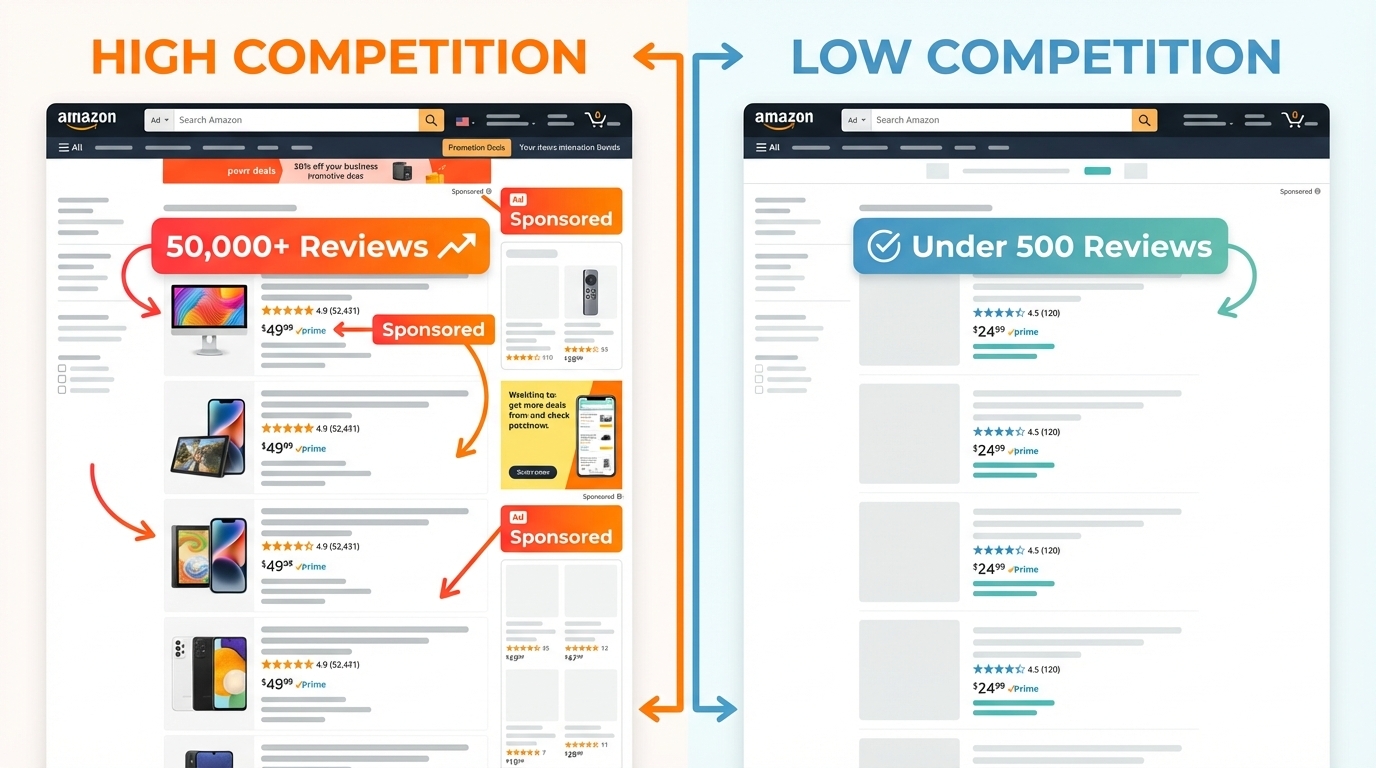
Low competition ≠ low demand (you need both)
A common mistake is equating low competition with low demand. In reality, the most profitable opportunities exist where demand is steady and competition is fragmented. For example, "ergonomic standing desk mat for concrete floors" has lower search volume than "standing desk," but far less competition and higher buyer intent.
The 3 competition layers: SERP, offer, and brand dominance
Competition on Amazon isn't just about how many sellers are in a niche. It's layered:
- SERP Competition: How many sponsored listings? What's the average review count in the top 10?
- Offer Competition: Are competitors offering bundles, warranties, or superior content?
- Brand Dominance: Is one brand (e.g., Anker, Tile) controlling 60%+ of the top results?
The "blue ocean" misconception: why most niches are "lightly contested," not empty
There's no such thing as a completely uncontested niche on Amazon. The goal isn't to find a "blue ocean" with no fish; it's to find a "light blue" pond where you can swim faster than others. Most successful private label brands win by dominating long-tail variations of broader categories.
Definition Box: What is a Low Competition Niche?
A low competition niche on Amazon is a product category with sufficient buyer demand but limited dominance by established brands or high-review sellers. It allows new entrants to rank and convert with reasonable ad spend and product differentiation.
- Low competition = median review count < 300 in top 10
- Low competition = no single brand in >5 of top 10 spots
- Low competition = ≤3 sponsored ads on first page
- Low competition = clear content or feature gaps in top listings
Set Your Filters Before Research (So You Don't Chase Bad Niches)
Before diving into research, define your constraints and success criteria. This prevents emotional decisions and ensures you only evaluate niches that align with your business model. Think of this as your "pre-flight checklist" for product research.
Your constraints checklist (budget, margin, size/weight, compliance, seasonality)
Ask yourself:
- What's my maximum FBA prep and shipping cost per unit?
- Can I handle inventory for seasonal products (e.g., holiday decor)?
- Am I compliant with FDA, CPSC, or FCC regulations for this category?
- Is the product size/weight suitable for standard FBA fees?
Your success criteria (target price band, break-even ACoS, review threshold)
Define what "winning" looks like:
- Target price: $25-$45 (high enough for margin, low enough for impulse buys)
- Break-even ACoS: ≤35% (based on 30% gross margin)
- Max acceptable review count for top competitors: 1,000
The "avoid list" (hazmat, high return-rate items, restricted claims)
Some niches are landmines. Avoid:
- Hazmat items (batteries, aerosols)
- Products with >15% return rate (e.g., apparel without sizing guides)
- Items requiring restricted claims (e.g., "medical device," "FDA-approved")
Step 1: Generate Niche Ideas Using Buyer Language (Keywords First, Not Products)
Most sellers start with products. Winners start with problems. Use buyer language (phrases people type when they're ready to buy) to uncover real demand. This is the foundation of effective Amazon product research.
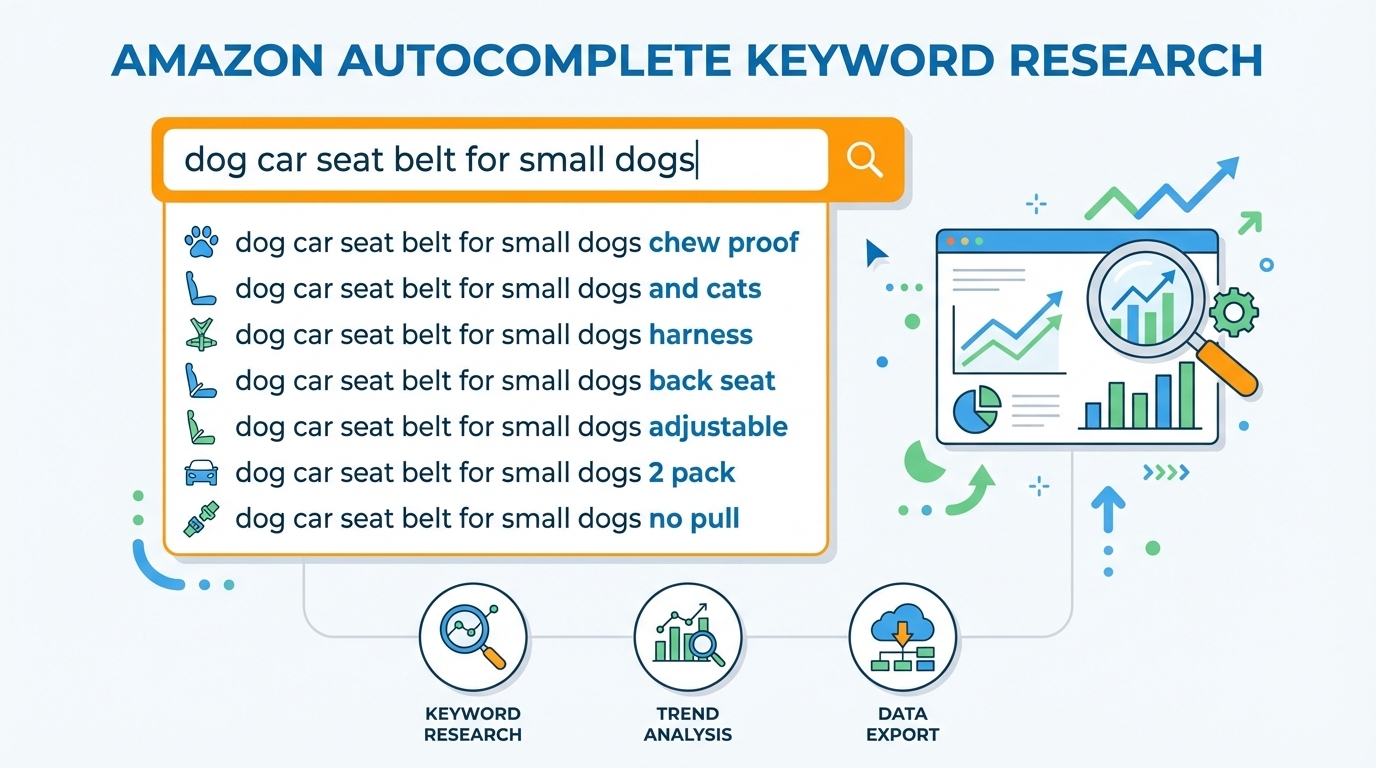
Start with problem/use-case phrases (buyers don't search "SKU," they search solutions)
Instead of "dog leash," think: "hands-free dog leash for running," "tangle-free dog leash for two dogs," or "short dog leash for city walking." These reflect real pain points and buying intent.
Expand with Amazon-native signals
Leverage Amazon's own data:
Autocomplete mining (A-Z + modifier stacking)
Type a base keyword (e.g., "yoga mat") and note all autocomplete suggestions. Stack modifiers: "non-slip," "extra thick," "eco-friendly," "for hardwood floors."
Category filters and attributes (material, size, pack, compatibility)
Browse category filters. For "coffee mugs," look at: material (ceramic, stainless steel), size (12 oz, 16 oz), pack count (set of 4), compatibility (dishwasher safe, travel lid).
Build "niche clusters" (one niche = one intent cluster, not one keyword)
Group related keywords into clusters. Example:
- "ergonomic office chair for tall people"
- "high back desk chair for long hours"
- "lumbar support chair for back pain"
This cluster represents a single niche: office chairs for people with back pain.
Step 2: Validate Demand (Without Falling for a One-Keyword Trap)
Don't fall for a single high-volume keyword. True demand is broad and stable. Use tools like SellerSprite Product Research to analyze search volume across the entire cluster.
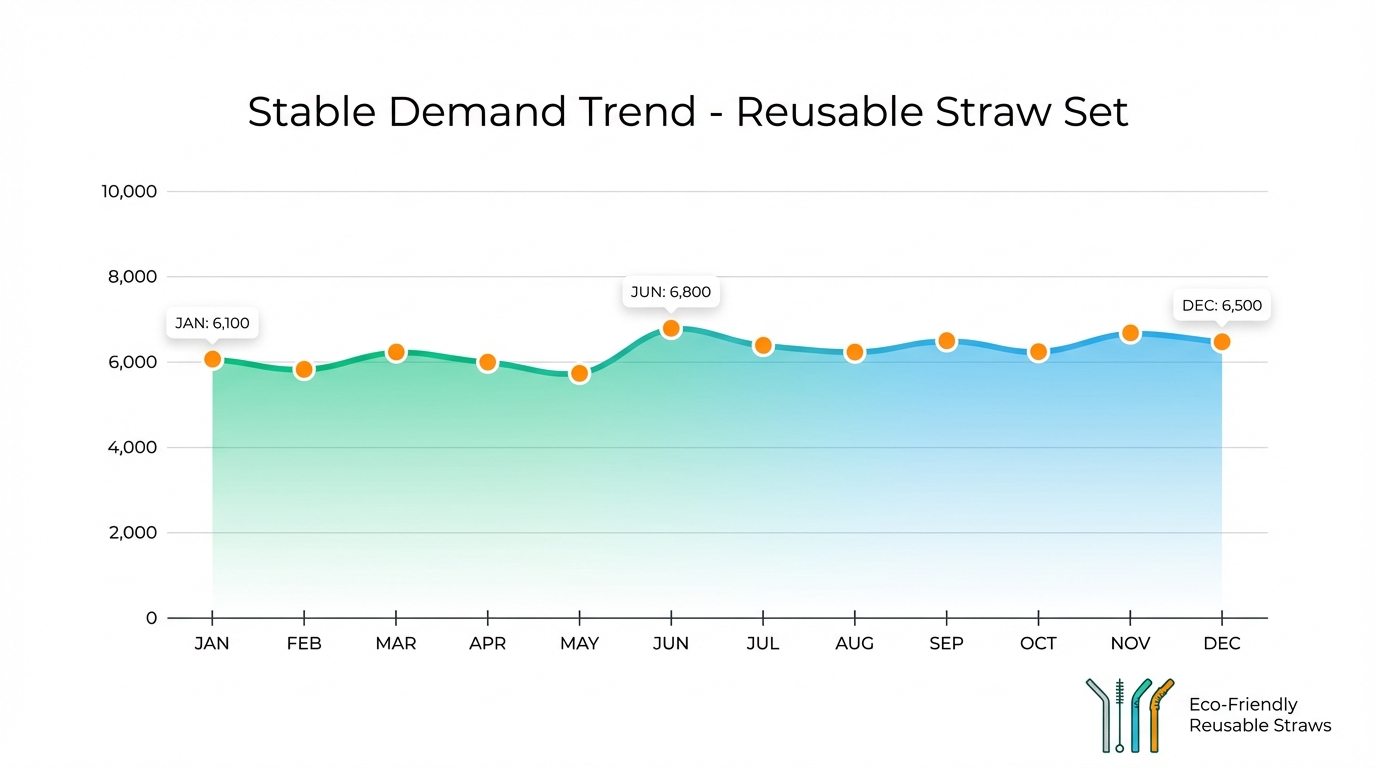
Demand breadth: look for clusters with multiple relevant long-tails
A niche with 5 keywords each at 1K-3K monthly searches is better than one with a single 10K-term and nothing else. Breadth reduces dependency on one term.
Trend stability: evergreen vs. seasonal vs. spike-driven
Check historical trends. Is demand consistent year-round? Spiking around holidays? Or driven by a viral TikTok trend?
Quick rule: stable demand > viral spikes (unless you can move fast)
Evergreen niches (e.g., kitchen gadgets, pet supplies) are safer for long-term growth.
Buyer intent check: "Are shoppers ready to buy or just browsing?"
High-intent keywords include: "buy," "best," "review," "for [specific use]." Low-intent: "ideas," "types," "DIY."
Decision Tree: Is Demand Valid?
If demand is narrow (1-2 keywords) → Reject
If demand is broad but seasonal → Watchlist (assess inventory risk)
If demand is broad and stable → Continue
Step 3: Measure Competition on the SERP (A Practical Checklist)
Now analyze the first page of Amazon search results. This "SERP Snapshot" tells you if the niche is winnable.
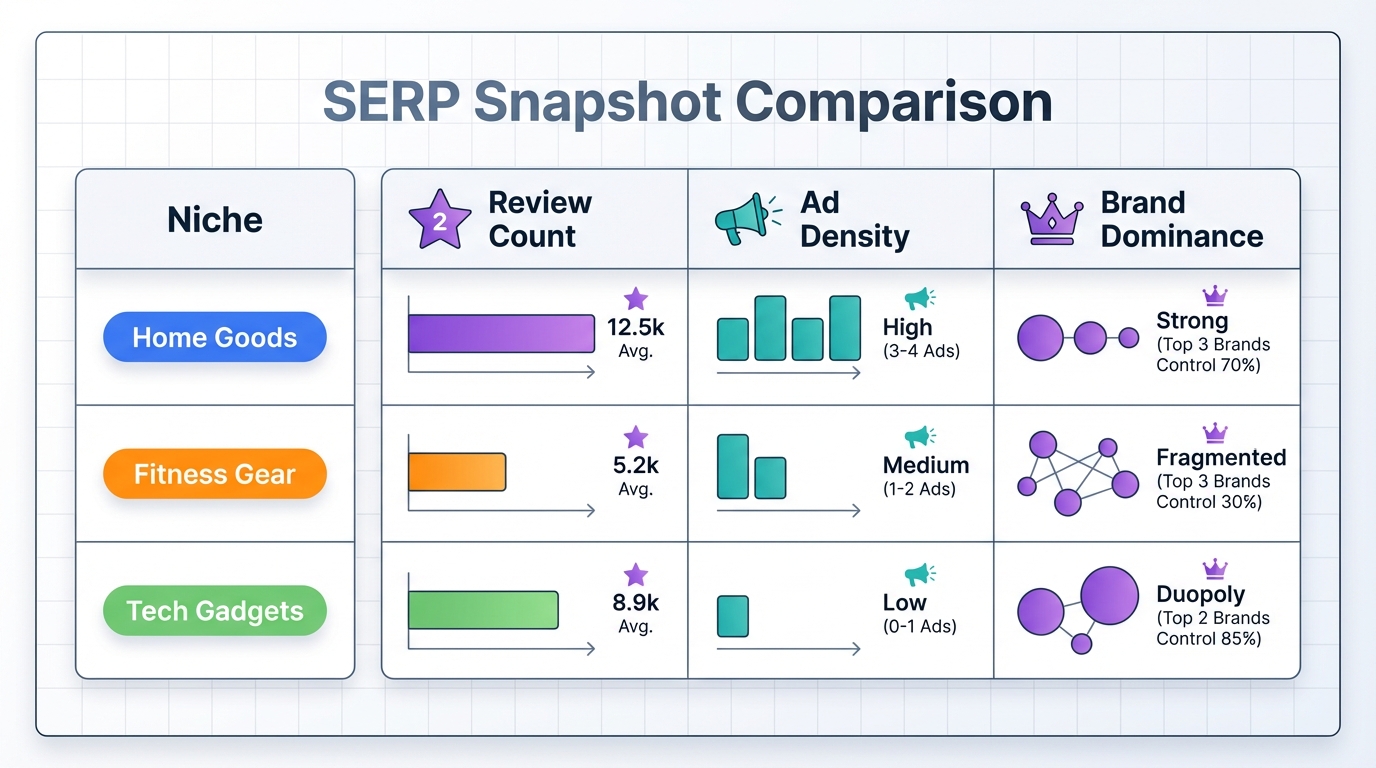
SERP difficulty signals to record
Review moat: median reviews in top 10 results
If the median is over 1,000, it's a high barrier. Under 300? You can compete.
Rating strength: how many are 4.5+ with high volume
A 4.8-star product with 2,000 reviews is a fortress. A 4.7 with 200 reviews is beatable with better content.
Content quality: image quality, A+, video, clear differentiation
Poor images or generic bullet points = opportunity to win on presentation.
Ad density: how many sponsored placements dominate page one
More than 3 ads? High competition. Low ad presence suggests lower profitability or easier entry.
Brand dominance test (is the niche controlled by 1-2 brands?)
If one brand appears 6+ times in the top 10, they likely dominate reviews, ads, and buy box algorithms.
Variation complexity: do leaders win via huge variation matrices?
Sellers with 20+ variations (color, size, bundle) can suppress new entrants. Simpler variation sets are easier to challenge.
Step 4: Keyword-Level Competition (Find Easy-to-Win Long-Tail Entry Points)
Even in competitive niches, long-tail keywords offer entry points. Target phrases with clear intent but weak listing alignment.
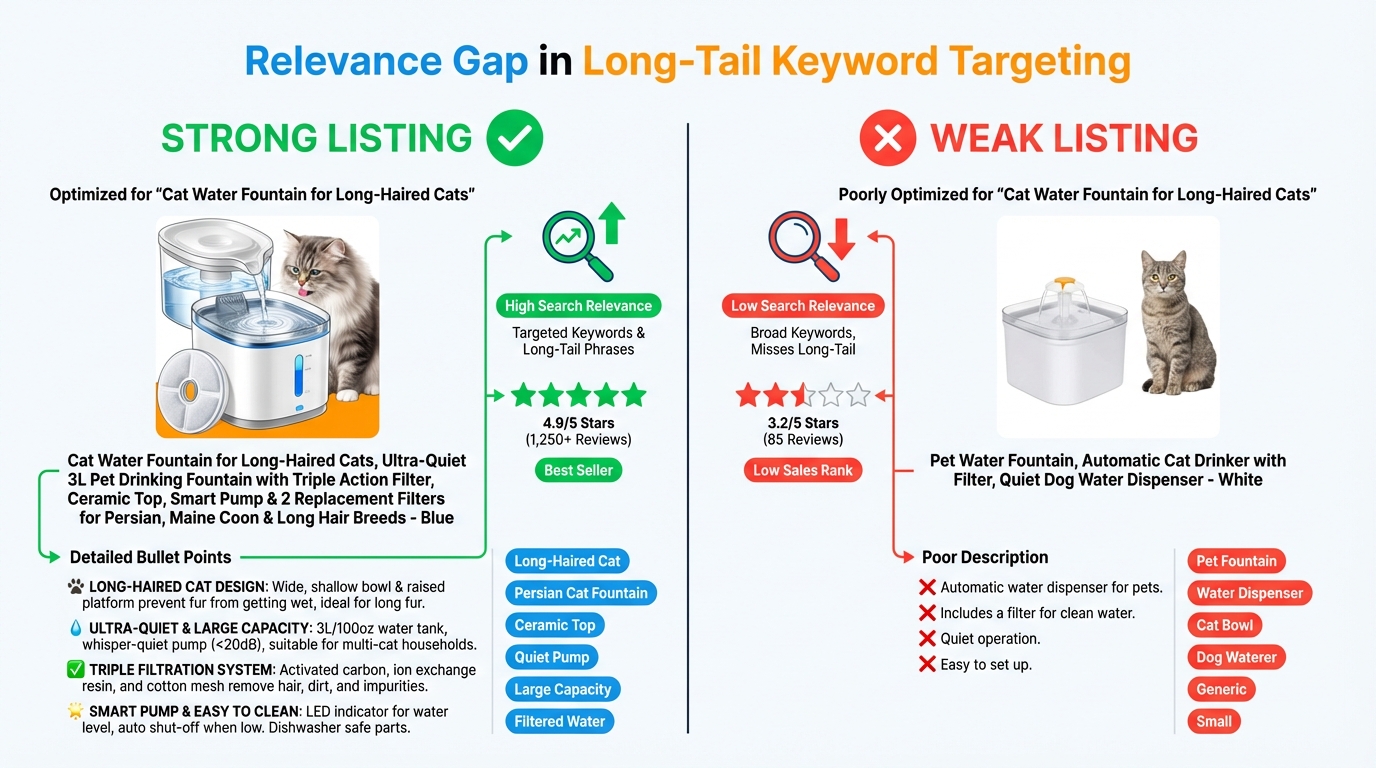
Look for long-tail keywords with clear intent and weak listing alignment
Example: "quiet cat water fountain for light sleepers": if top results don't mention noise level, you can win with a "whisper-quiet" claim.
Spot "relevance gaps" (buyers search it, but results don't match perfectly)
Use SellerSprite's keyword relevance score to find mismatches between search intent and listing content.
Build a "launch ladder"
Start with low-competition long-tails, then expand:
Long-tail (win) → mid-tail (expand) → head term (optional later)
Example: "organic cotton baby washcloths" → "baby washcloths" → "baby towels."
Step 5: Economics Reality Check (Low Competition That Can't Profit Still Fails)
A niche might be low competition, but if it can't generate profit after fees and ads, it's a trap. Run the numbers.
Price band + margin math (can you survive PPC and fees?)
At $30 price: $12 COGS + $8 FBA = $20 cost. $6 ad spend = $26 total. $4 profit = 13% margin. Is that enough?
PPC feasibility proxy: expected CPC vs. break-even ACoS
If break-even ACoS is 35% and CPC is $1.20, max bid = $0.42. Can you get clicks at that bid?
Operational complexity: returns, breakage, sizing confusion, seasonality inventory risk
A fragile item with high return rates can erase profits even if sales are strong.
Step 6: "Blue Ocean Score": A Simple Scoring Model to Rank Niches
Use this formula to objectively compare niches:
Opportunity Score = Demand × Intent × Ability-to-Win × Profitability × Operational Fit
Each factor scored 1-5. Example:
| Factor | Score | Notes |
|---|---|---|
| Demand | 4 | Broad, stable, 5K+ monthly volume |
| Intent | 5 | High-buyer-intent keywords |
| Ability-to-Win | 3 | Moderate review moat |
| Profitability | 4 | 30% margin after ads |
| Operational Fit | 5 | Lightweight, no compliance issues |
Total Score: 4 × 5 × 3 × 4 × 5 = 1,200
Reject rules (e.g., brand dominance = 1, review moat extreme = 1)
If any factor scores 1, reject the niche. No amount of demand justifies an unwinnable market.
Prioritize your top 3 niches for deeper validation
Focus your resources. Don't spread thin across 10 mediocre ideas.
Step 7: Deep Validation Before You Commit (Fast Tests That Save Money)
Before ordering inventory, validate further:
Reverse-engineer competitors (Reverse ASIN) to confirm demand clusters
Use SellerSprite's Reverse ASIN tool to see which keywords top sellers actually rank for.
Read reviews to find differentiation angles customers actually care about
Look for repeated complaints: "broke after 2 weeks," "too small," "instructions unclear." These are product improvement opportunities.
"Test before invest" options (small batch, PPC discovery, listing draft validation)
Launch a small batch. Run a PPC campaign to a draft listing to gauge click-through rate and conversion intent.
Common Mistakes When Searching for Low Competition Niches
Avoid these pitfalls:
Choosing low demand niches and calling them "low competition"
No sales = no competition. That's not a niche; it's a dead end.
Ignoring review moat and brand dominance
Even if search volume is high, you can't compete with 10K-review giants without a massive ad budget.
Chasing high-volume head terms (expensive and saturated)
"Yoga mat" has 150K searches, but 80% of traffic goes to the top 3 listings. Target "non-slip recycled yoga mat" instead.
Forgetting operational and compliance constraints
A great niche on paper fails if it requires special storage, certifications, or has high return rates.
Mini Walkthrough: A 30-Minute Niche Check
Follow this fast SOP:
Pick one keyword cluster → capture SERP snapshot
Example: "ergonomic office chair for tall people."
Score demand + competition + economics
Use the Blue Ocean Score model.
Decide: proceed / watchlist / reject
Document your rationale. Repeat for 2-3 clusters.
FAQ
How do I find low competition niches on Amazon for private label products?
Start with buyer problem phrases, build keyword clusters, validate demand breadth, analyze SERP competition (review count, brand dominance), and run an economics check. Use tools like SellerSprite to automate data collection and scoring.
What tools can help me identify untapped product opportunities on Amazon?
SellerSprite's Product Research and Reverse ASIN tools help uncover low competition keywords, analyze competitor traffic, and validate niche profitability. Other options include Helium 10 and Jungle Scout, but SellerSprite offers superior keyword relevance scoring and demand clustering.
What are the most profitable low competition niches on Amazon in 2026?
While trends evolve, evergreen categories like pet accessories, home organization, and eco-friendly consumables continue to offer opportunities. Look for sub-niches with modifiers like "for seniors," "compact," or "travel-friendly" to find less saturated segments.
How often should I re-check niche competition?
Re-evaluate every 3-6 months. Markets shift quickly on Amazon. New entrants, ad spend changes, or algorithm updates can alter competitiveness even in stable niches.
Next Steps
- Use SellerSprite to generate your first 10 keyword clusters.
- Apply the 7-step framework to validate and score your top 3 niches.
- Run a small-batch test or PPC validation before full launch.
References
- Amazon Product Research Guide View
- Advanced Amazon Product Research Playbook View
- Discover High-Potential Amazon Products View
By SellerSprite Success Team
The SellerSprite Success Team combines 10+ years of Amazon FBA expertise, data science, and e-commerce growth strategy. We help new and scaling sellers find profitable niches using AI-powered research tools validated across thousands of product launches.