Each week, new best Temu finds lists go viral on TikTok and deal blogs, but not every trending gadget can win on Amazon. Instead of copying product lists, smart sellers ask two questions: why is Temu so cheap, and which Temu winners can survive Amazon fees, returns, and ad costs.
This guide explains the Temu vs. Amazon pricing gap, then provides a repeatable Temu product research workflow you can hand off to a VA or junior operator. It is a Temu-to-Amazon winners SOP designed to be executed quickly, tracked weekly, and improved with objective metrics.
Experience note: The playbook below is distilled from recurring seller workflows and internal QA patterns we see when validating low-price, high-velocity products across marketplaces. Use it as a decision system, not as a guarantee.
Key takeaways
A quick summary for Amazon sellers who want to validate the best Temu finds with a Temu-to-Amazon SOP.
- Temu is cheap because it optimizes for velocity at extreme price points through factory-direct supply, heavy incentives, consolidated shipping, and price-first merchandising.
- The best Temu finds that transfers to Amazon are usually small, light, simple items with clear before-and-after value and low compliance risk.
- Use a 7-step Temu to Amazon SOP: collect signals, build a keyword funnel, select competitor ASINs, model contribution margin, run compliance and IP checks, craft conversion assets, and test small and iterate.
- Make decisions with a 3-day, 7-day, 14-day scorecard using CTR, CVR, ACoS, early returns, and margin stability.
- Risk and compliance: Do not dropship Temu orders into Amazon. Avoid IP conflicts, restricted claims, and certification-heavy categories.
Table of contents
Jump to the section you need. Each item is a direct link.
Tip: Keep a "Back to top" link at the end of the article for easy navigation.
What Temu is really optimizing for
Temu optimizes for velocity and reach at extreme price points. The question of why Temu is so cheap is more straightforward to answer when you map incentives across supply, demand, logistics, and marketing. It is a deliberate play that trades margin for penetration.
Temu price engine in one picture
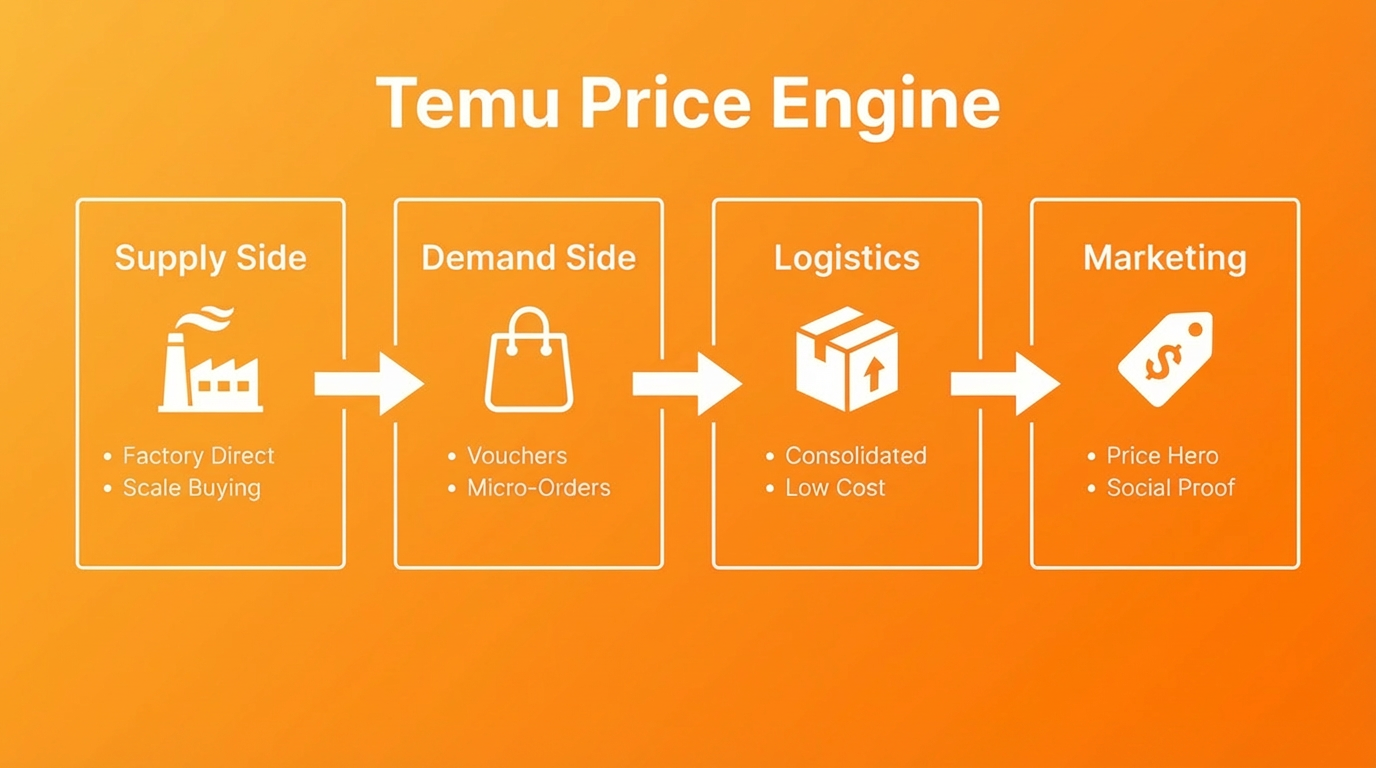
What this means: Temu wins by compressing costs and expectations simultaneously. Your Amazon version must raise perceived value and reduce returns, or the unit economics break.
- Copy the pattern: small, simple SKUs with fast iteration and clear use cases.
- Adjust for Amazon: better images, stronger packaging, more explicit claims, and a price tier that can support fees and returns.
Price-band implications for Amazon: ultra-low prices can be a trap once you factor in referral fees, FBA or FBM shipping, returns, and ads. The sweet spot often shifts up one tier, where perceived value can protect margin while still matching the Temu buyer trigger.
Best Temu finds traits you can measure
Most viral Temu TikTok products cluster in small, light categories with predictable landed costs. Your job is to translate hype into measurable signals before you buy inventory.
Price bands and form factor
- Small and light items that tolerate shipping variance and minimal packaging.
- Simple materials or molds, low component count, low breakage rate.
- Room for bundling: multi-packs, accessories, storage add-ons, or color sets.
Review language patterns you can reuse ethically.
Look for repeating words that signal the buyer promise. Positive themes often center on easy wins: fits, cute, solves a minor annoyance, and works as described. Negative themes frequently cluster on durability, sizing, and color accuracy.
Those terms map directly into Amazon listing copy, image callouts, and objection handling. Do not copy competitor text. Extract themes, then write your own.
Lifecycle archetypes
- Flash trends: spike and fade. You win by speed, small tests, and quick exits.
- Utility long tail: grows steadily through evergreen keywords. You win by CVR, reviews, and supply stability.
Quick validation check using SellerSprite
For each candidate, run Temu trend validation on Amazon like this:
- Expand keywords around the core function and common synonyms using SellerSprite Keyword Mining.
- Pull 5 to 10 reference ASINs and extract review themes with Review Analysis (or export the key phrases your team keeps seeing).
- Check seasonality and category dynamics using Product Research and your category trend view.
- Track short-list items in Product Tracker to catch price compression and new entrants early.
Tip for teams: you can complete this validation pass in under 10 minutes per item once your spreadsheet fields are set.
Temu vs Amazon: transferable playbooks and hidden risks
Here is the practical translation layer. This section answers: which parts of the Temu playbook transfer to Amazon, and which parts turn into risk.
Responsible selling note: This article is for product research and listing optimization. It is not legal advice. When in doubt, consult a qualified compliance professional for your category and marketplace.
Opportunity matrix positioning: the scoring framework below is the same style of decision lens our internal team uses to filter Temu-to-Amazon projects quickly. It is meant to reduce bias and make weekly reviews consistent.
What you need before you start (US and EU notes)
- A seed list sourced from best Temu finds roundups and social clips (TikTok viral products, deal lists, creator short reviews).
- SellerSprite access for keyword expansion, competitor ASIN analysis, category trend charts, and rank monitors.
- A landed cost model including product, packaging, inbound freight, FBA or FBM fees, ads, and a returns reserve.
- A compliance checklist for your target category (materials, labeling, claims, safety documentation).
- A creative workflow for main images, infographics, and a short demo video.
GEO notes for US sellers
- Do not assume Temu's style of direct-to-consumer shipping economics will match your Amazon fulfillment model. Model fees and returns first.
- If you rely on imported inventory, track policy changes that can affect low-value parcel costs and lead times.
GEO notes for EU and UK marketplaces
- VAT, product compliance, and extended producer responsibility obligations can change, which Temu-inspired products are viable in Germany, the UK, France, and Italy.
- If your product touches safety, electronics, kids, or health claims, treat compliance as a first step, not a last step.
7-step Temu to Amazon SOP (VA-ready)
Method label: This is a repeatable, delegation-friendly SOP for VAs and junior operators. The goal is to turn Temu signals into an Amazon shortlist you can test safely, with clear stop rules.
- Collect signals
Start with 30 to 50 items from the best Temu finds roundups, creator clips, and search phrases like "temu finds" and "best temu finds". Tag by category, price band, and form factor. Remove obvious brand conflict items.
Tool hint: save candidates into My Product List so your team can review weekly. - Build a keyword funnel
In SellerSprite, expand two or three core phrases per item. Add how, for, with, size, color, and material variants. Map search volume and difficulty. Flag evergreen terms that do not depend on temporary discount traffic.
Complete fast with: Keyword Mining and Reverse ASIN. - Select competitor ASINs
Choose 5 to 10 ASINs that align with function and price intent. Compare the main images, title patterns, bullets, A+ content, and review themes. Note which social proof angles can be replicated truthfully.
Complete fast with: Competitor Research. - Break down the total cost and the contribution margin
Estimate product and packaging, inbound freight, FBA or FBM fees, returns reserve, and a small ad test budget. Compute contribution margin at three price points. Pick a price tier that can survive returns and ads.
Tip: treat return rate as a real cost line item, not a surprise. - Run compliance and IP checks
Confirm materials, labeling, testing, restricted claims, and potential design conflicts. Remove borderline items early.
Account safety warning: Do not dropship Temu marketplace orders into Amazon. Do not use trademarked brand names, and do not copy competitor images or claims. - Craft conversion assets
Rewrite bullets using extracted review themes. Turn the top two objections into visual callouts. Build a lifestyle hero image and one infographic that shows dimensions, fit, or capacity. Keep copy direct and specific.
Complete fast with Listing Builder and Ads Insights for keyword-to-ad alignment. - Test small and learn fast
Launch with a low initial inventory and a modest exact-match ad set. Collect structured feedback for the first 20 to 40 orders. Adjust the listing within the first week based on CTR and conversion patterns.
Complete fast with: Keyword Tracker and Product Tracker.
Copy the SOP fields into your weekly shortlist.
Use the spreadsheet field list below to standardize VA research. Save candidates in My Product List, then review the same metrics every week.
Numbers that decide your next move (3-day, 7-day, 14-day)
The fastest way to lose money on a Temu-inspired launch is to keep spending without a decision system. Use a simple scorecard with fixed checkpoints.
Simple scorecard example (copy into your sheet)
Templates and downloads
Use these fields inside a simple spreadsheet. Keep each candidate on a single row so weekly reviews stay fast.
Temu to Amazon SOP table fields
- Lead source
- Core keywords and long tail set
- Target category
- Reference ASINs
- Target price band
- Estimated cost of product, logistics, and platform
- Compliance notes
- Main image hook
- Copy highlights
- First batch inventory
- Ad budget week one
- Seven day metrics: CTR, CVR, ACoS
- Fourteen day metrics: orders, reviews, returns
- Decision: scale, adjust, stop
Opportunity matrix scoring fields
Positioning: this scoring set is a quick filter used to decide whether a Temu to Amazon project is worth testing.
- Category maturity
- Logistics difficulty (size and weight)
- Compliance risk
- Review volatility
- Price competition intensity
- Differentiation space
- Margin elasticity
- Seasonality pressure
- Supply stability
- Creator and content fit
- Total score and action: enter, trial, watch, avoid
Routing rule suggestion: enter at 38 or higher. Trial at 30 to 37. Watch at 24 to 29. Avoid below 24.
Mini case study with metrics
Data note: the metrics below are illustrative and anonymized examples based on common Amazon launch patterns. They show how to evaluate a Temu-inspired test, not what you should expect.
Product: adhesive cable clips with a matte finish. Small and light with simple molding.
Keywords: cable clip organizer, desk cord holder, wire management adhesive.
Competitor ASINs: 10 listings clustered at the lowest price. Images lacked true scale and real desk context.
Actions taken:
- Added a true-to-scale hand photo and a size grid showing width and height.
- Bullets addressed two repeat objections: adhesive residue and grip on textured surfaces.
- Added a small insert card with removal steps to reduce returns and buyer messages.
- Used a 5-pack bundle at a mid-tier price to raise perceived value without complexity.
Seven-day snapshot:
- CTR improved from 0.8% to 1.4% after the main image update.
- Conversion rate stabilized around 14% to 16% once sizing was clarified.
- ACoS held under target after narrowing to higher intent keywords.
- Buyer messages about removal dropped after the insert card update.
Fourteen-day decision: scale cautiously with more inventory and one color variation, while monitoring returns, reviewing language, and price compression weekly.
What made it transferable: a micro utility item with simple expectations, a clear use case, low defect risk, and an easy way to reduce objections with better images and packaging.
FAQ: Temu to Amazon for Amazon sellers in the US and the EU
Why is Temu so cheap?
Short answer: Temu trades margin for growth by combining factory direct supply, aggressive incentives, consolidated shipping, and price-first merchandising. That system works best for novelty and small utility items where expectations are flexible.
Can I copy the best Temu finds directly to Amazon?
Short answer: Copying lists rarely works. You need keyword fit, clear images that resolve doubts, and a price that can survive fees and returns. Some items transfer well. Others rely on subsidies and relaxed expectations that do not exist on Amazon.
How do I keep margin when competing with Temu-inspired items?
Short answer: move up one price tier with bundles or accessories, then reduce returns with better images and packaging. Focus on evergreen keywords, not discount-driven traffic.
Is Temu dropshipping on Amazon a good idea?
Short answer: no. It introduces delivery uncertainty, documentation gaps, and account risk.
Compliance warning: build a reliable supply path, hold verified inventory, and ship through an Amazon-compliant fulfillment method.
Does a low price hurt brand value in the long term?
Short answer: Racing to the bottom erodes brand equity. Pair fair pricing with reliable outcomes, clear benefits, and a consistent customer experience. Use bundles and design details to add value without stepping into subsidy territory.
Does this Temu to Amazon SOP work for the EU and UK marketplaces?
Short answer: The research workflow works, but the product filter must be stricter.
- Treat VAT and compliance documentation as a first step, not a cleanup step.
- Avoid categories with high safety risk or restricted claims unless you have strong documentation.
- Localize listing claims, sizing language, and returns expectations for each marketplace.
How should a lean team test quickly?
Short answer: run the 7-step SOP, keep tests small, change one variable at a time, and decide on Day 3, Day 7, Day 14 using the scorecard.
Operational tip: assign one owner for keywords, one owner for images, and one owner for the weekly scorecard review. That separation reduces trash.
Turn Temu signals into Amazon wins with SellerSprite. Use the SOP fields above to build your shortlist and validate three products this week. Start your free trial now and get access to keyword research, competitor ASIN analysis, category trends, and rank monitors.
About the author
SellerSprite editorial team. We build practical workflows for Amazon sellers by turning marketplace data into repeatable operating systems that cover keyword research, competitor analysis, listing optimization, and trend validation.
References
- Omnisend survey coverage on consumer trust and shopping behavior: Retail Dive summary
- Omnisend report methodology and country insights: Temu vs Amazon report
- Omnisend analysis on product overlap and average price differences: Price, trust, and competition
- US de minimis overview (Section 321): US Customs and Border Protection
- US executive order publication on suspending duty-free de minimis treatment: Federal Register
- EU policy discussion on low-value parcel duties and pressure on cheap imports: Reuters
Share Your Sourcing Journey With SellerSprite Community
Join the SellerSprite community on the Facebook Group to share your sourcing journey, ask questions, and get support from fellow Amazon sellers.
View The SellerSprite Course Directory
Ready for the next step? Open the SellerSprite Academy course directory to continue building your Amazon FBA skills chapter by chapter.