A repeatable outreach system, a proven Alibaba supplier message template, and a scoring method to pick the right factory faster.
If you are searching for how to contact Alibaba suppliers without getting ignored, this guide gives you a practical system. You will learn what to prepare, how to write a short first message that gets replies, the best questions to ask Alibaba suppliers, and how to compare suppliers from their responses with a simple scoring sheet.
Key takeaways
- Contact 10 to 30 suppliers, then filter quickly. Do not bet on 1 or 2 replies.
- Keep the first message short and structured, use numbered questions so suppliers can answer fast.
- Ask for price tiers, MOQ, lead time, sample cost, and shipping in one message to avoid slow back and forth.
- Score suppliers on price, MOQ, lead time, communication quality, certifications, and market experience, not price alone.
- Use platform protections and clear written terms, especially for quality and shipping timelines.
Before contacting Alibaba suppliers
Clarify product specs and target price
Suppliers reply faster when your request is specific. Before you message anyone, create a one page spec card so every supplier quotes the same thing.
- Product name and Alibaba link you are referencing
- Material, dimensions, weight, color options
- Quality requirements (examples: thicker material, reinforced seams, food contact safe)
- Branding needs (logo placement, printing method, customization MOQ)
- Packaging requirements (box type, inserts, barcode labels)
- Target landed cost and your order plan (test, first order, scale)
Decide your order plan (test, first, scale)
You do not need to pretend you are a giant brand, but you should sound like a serious buyer with a plan. A simple plan looks like this:
- Test: 1 to 2 samples per supplier
- First order: 300 to 800 units (or your niche's normal MOQ range)
- Scale order: 1000+ units with repeat orders
Pro Tip
In your first message, you can use your scale quantity as the inquiry quantity (example: 1000 units), even if your first paid order is smaller. This signals long term potential and often improves reply quality.
Common mistake
Contacting only 1 to 2 suppliers. You lose leverage, you get fewer comparable quotes, and you often choose the supplier who replied first instead of the best supplier.
How many suppliers should you contact and what reply rate is normal
A practical target is 10 to 30 suppliers. In many categories, a 30 to 60 percent reply rate is normal. Your job is to make replying easy, then filter quickly.
Example workflow you can replicate
Message 20 suppliers, shortlist 6 based on reply quality, request samples from 3, then pick 1 supplier after comparing sample quality, communication, and landed cost.
Add your own screenshots from this workflow to strengthen Experience and trust signals in the article.
How to use the Alibaba contact form like a pro
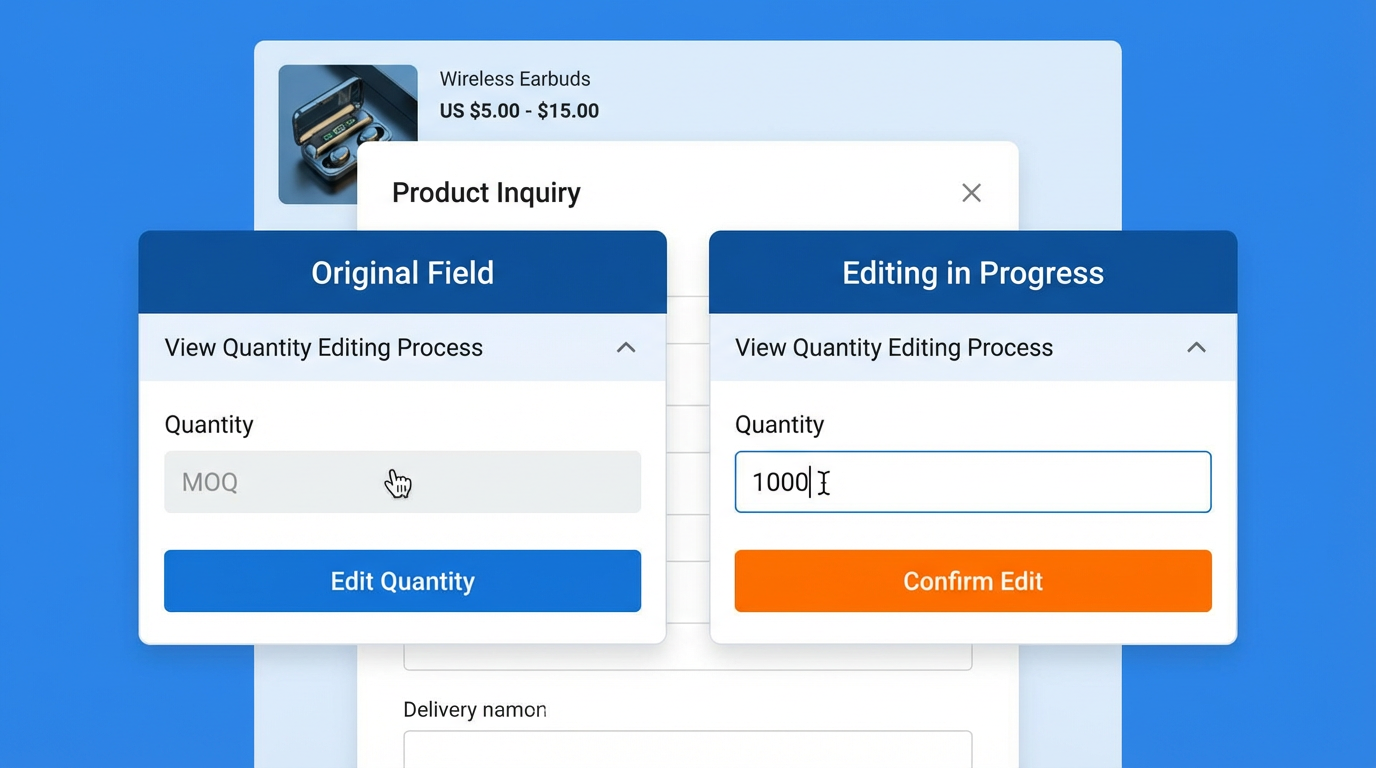
Adjusting quantity and expectations
Alibaba often auto-fills the supplier's MOQ in the quantity field. Edit it to your realistic scale number, then write your message. Suppliers triage inquiries fast, and a higher quantity can signal serious intent.
Attaching photos, logos, and packaging references
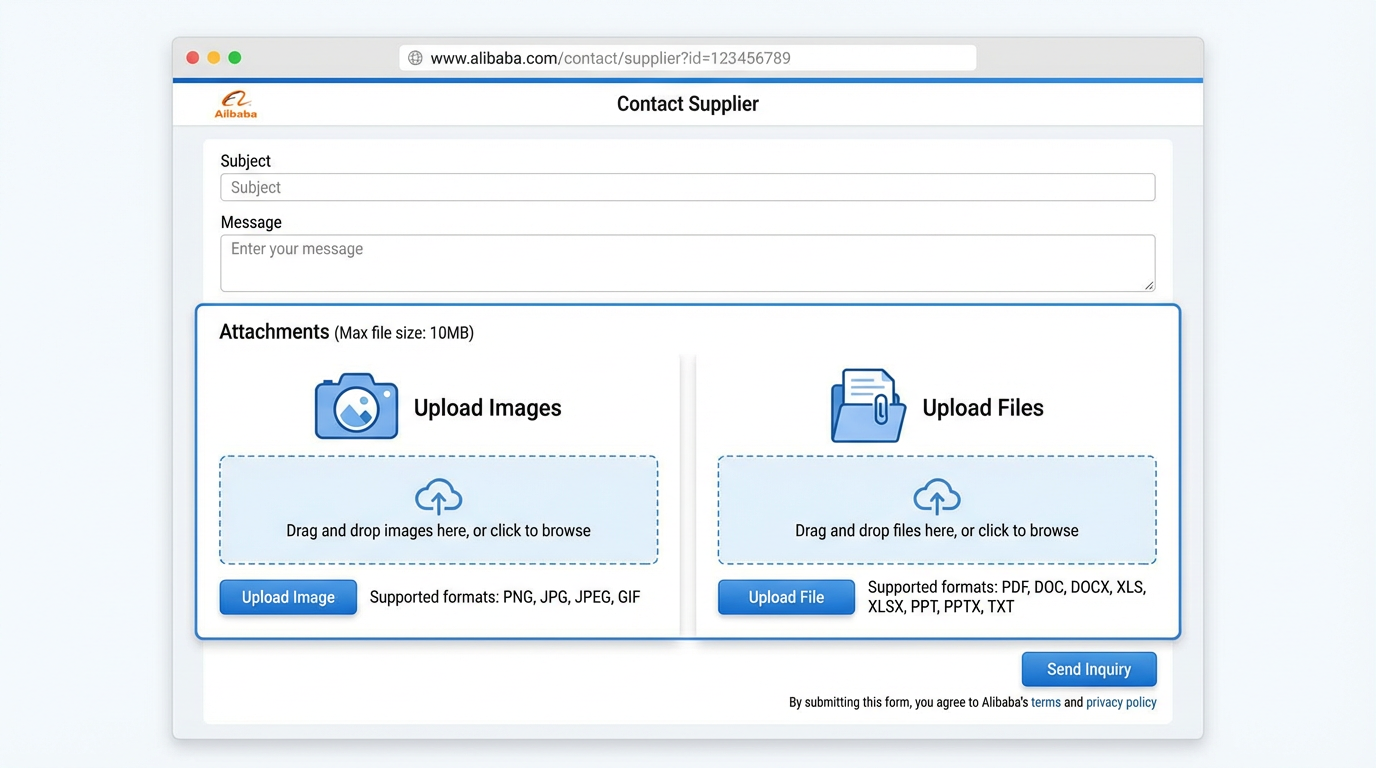
Attach 1 to 3 files max. Images reduce misunderstandings and speed up quoting.
- A reference photo of the exact product style you want
- Your logo file (optional if not ready)
- Packaging reference photo (box style, insert layout, label examples)
Common mistake
Writing a long paragraph without attachments. If suppliers cannot see what you mean, they either ignore you or ask vague follow-up questions.
Alibaba supplier message template
Recommended length and structure
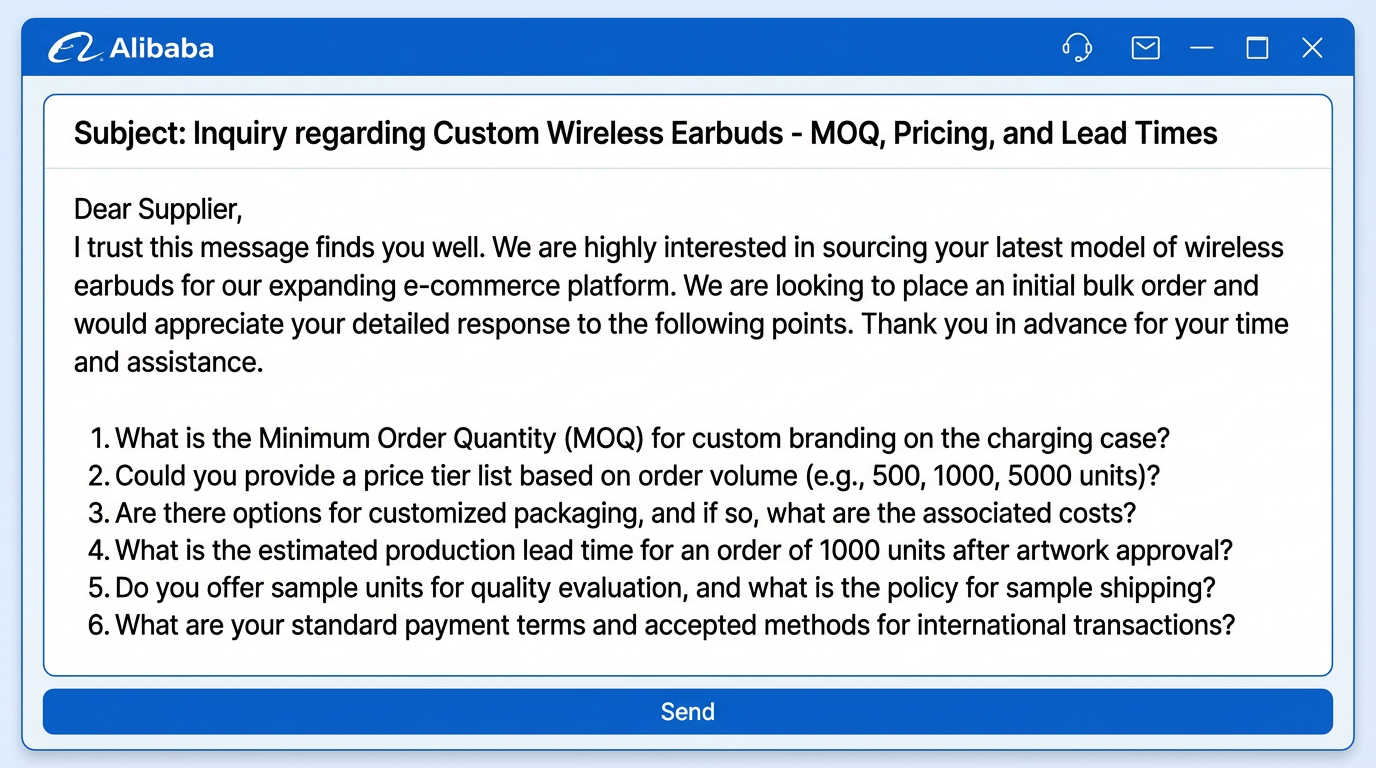
A strong first message is usually 120 to 180 words, plus a short numbered question list. Keep it professional, clear, and easy to answer.
| Block | What to write | Example |
|---|---|---|
| Greeting | Use the contact name | Hello Chris, |
| Role + market | Professional buyer role and target market | My name is [Name]. I am the purchasing manager at [Company], a [US or EU] brand. |
| Product reference | Product name and the exact link | We are interested in: [Product name]. Link: [Alibaba URL] |
| Requirements | 3 to 6 bullets of key specs | Material [X], size [X], color [X], logo on [location], packaging [type]. |
| Numbered questions | Make replying easy | 1) Price tiers 500, 1000, 3000 pcs? 2) MOQ and customization MOQ? 3) Lead time? 4) Sample cost + shipping? |
| Close | Timeline and long term intent | We are contacting multiple suppliers and plan to select within 2 to 3 weeks. We want long term repeat orders. |
Copy and paste: first message template
Alibaba supplier message template (copy and paste)
Hello [Name],
My name is [Your Name]. I am the purchasing manager at [Company], a [US or EU] brand selling in [category].
We are interested in the following product: [Product name].
Product link: [Alibaba URL]
Requirements:
1) Material: [X]
2) Size or weight: [X]
3) Color options: [X]
4) Logo: [location, method if known]
5) Packaging: [box type, inserts, labels]
If your factory can supply as described, please answer:
1) Unit price for 500, 1000, 3000 pcs?
2) MOQ and customization MOQ (logo, packaging)?
3) Lead time for sample and production at each quantity?
4) Sample cost and express shipping to [City, ZIP, Country]?
5) Shipping options and cost to [US warehouse ZIP] or [EU address] (include DDP if possible)?
6) Certifications available for our market (if applicable)?
We are contacting multiple suppliers and plan to select a partner within [2 to 3] weeks. We are looking for long term repeat orders.
Thank you.
Questions to ask Alibaba suppliers
Pricing and order terms
- Unit price at 3 quantities (test, target, scale)
- MOQ for product and MOQ for logo or custom packaging
- Payment terms (deposit percent, balance timing)
Production and quality
- Lead time for sample
- Lead time for each quantity tier
- Quality control process and what they check
- Can they share real photos or a short production video
Shipping and landed cost
- Carton size and carton weight
- Shipping options (air, sea, express) and estimated cost to your address or warehouse
- If you use DDP, ask what is included and what is excluded
How to compare and pick suppliers from replies
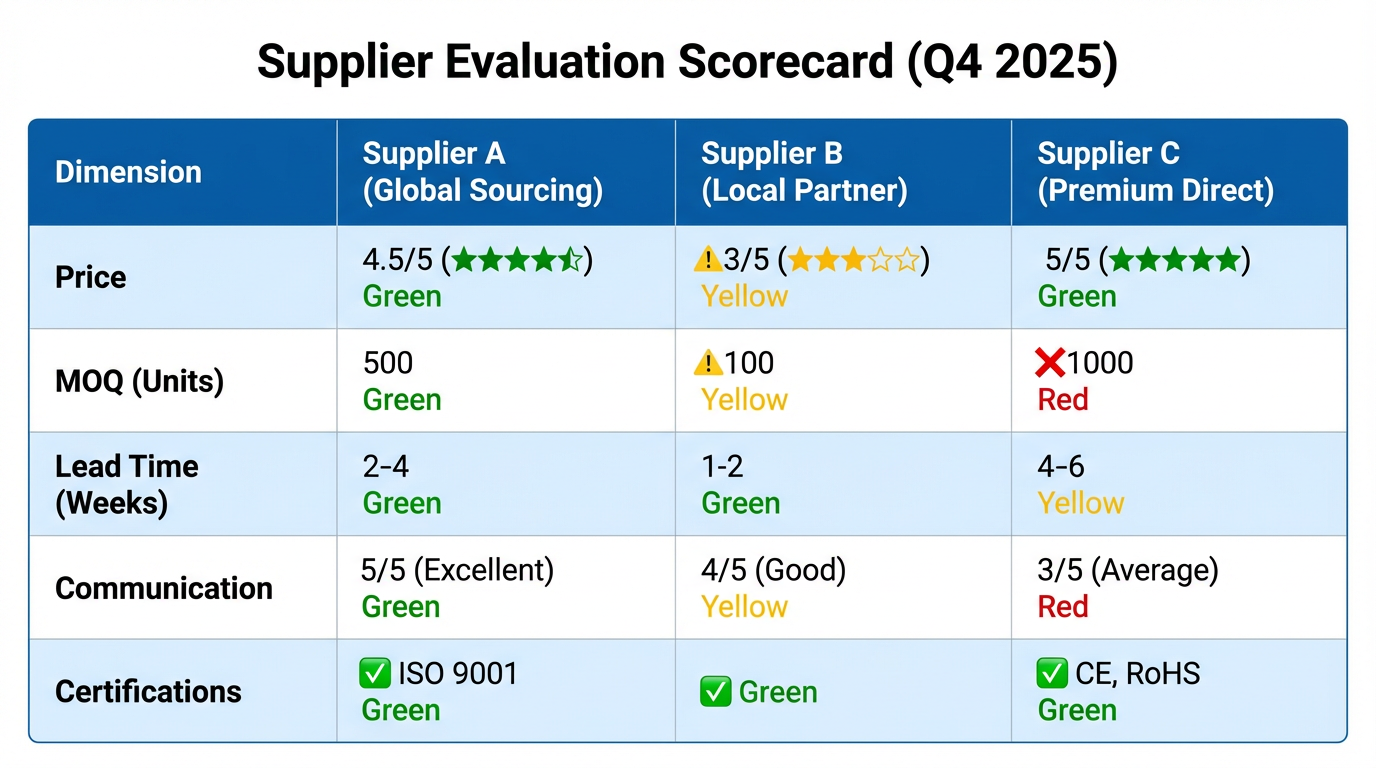
Most buyers compare only unit price. A better approach is to score suppliers on factors that predict fewer problems later: communication quality, lead time reliability, documentation readiness, and experience shipping to your market.
Step 1: Fast filter based on reply quality
- Green flag: answers your questions in a numbered format and includes assumptions
- Yellow flag: partial answers, unclear pricing, missing lead time
- Red flag: avoids direct answers, pushes off-platform payment immediately, or cannot quote basics
Pro Tip
If a supplier cannot answer a structured first message well, they usually cannot execute a structured production process well. Reply quality is often a preview of future cooperation quality.
Step 2: Use a simple supplier scoring sheet
| Dimension | What to check | Score (1 to 5) | Notes |
|---|---|---|---|
| Price competitiveness | Tier pricing is clear, assumptions are stated | [ ] | |
| MOQ flexibility | Product MOQ and customization MOQ are transparent | [ ] | |
| Lead time | Sample and production lead times are specific and realistic | [ ] | |
| Communication quality | Answers numbered questions, proactive, fast turnaround | [ ] | |
| Shipping support | Can quote to your region, offers options, understands DDP if needed | [ ] | |
| Certifications and docs | Knows what they have, can provide proof when needed | [ ] | |
| Market experience | Has shipped to US or EU buyers in your category | [ ] |
Step 3: Shortlist, then request samples
- Shortlist the top 3 to 5 suppliers by total score
- Request samples from the top 2 to 3 suppliers
- Negotiate seriously only after sample quality is confirmed
Shipping to US and EU compliance notes
Note
The exact requirements depend on your product category. Use these as early screening questions, not legal advice.
Shipping to US warehouse (FBA or 3PL)
- Ask for shipping quotes to a specific US ZIP code so suppliers quote accurately
- If you plan to use DDP, ask what is included (duties, taxes, delivery) and what is excluded
- Always request carton size and carton weight for landed cost planning
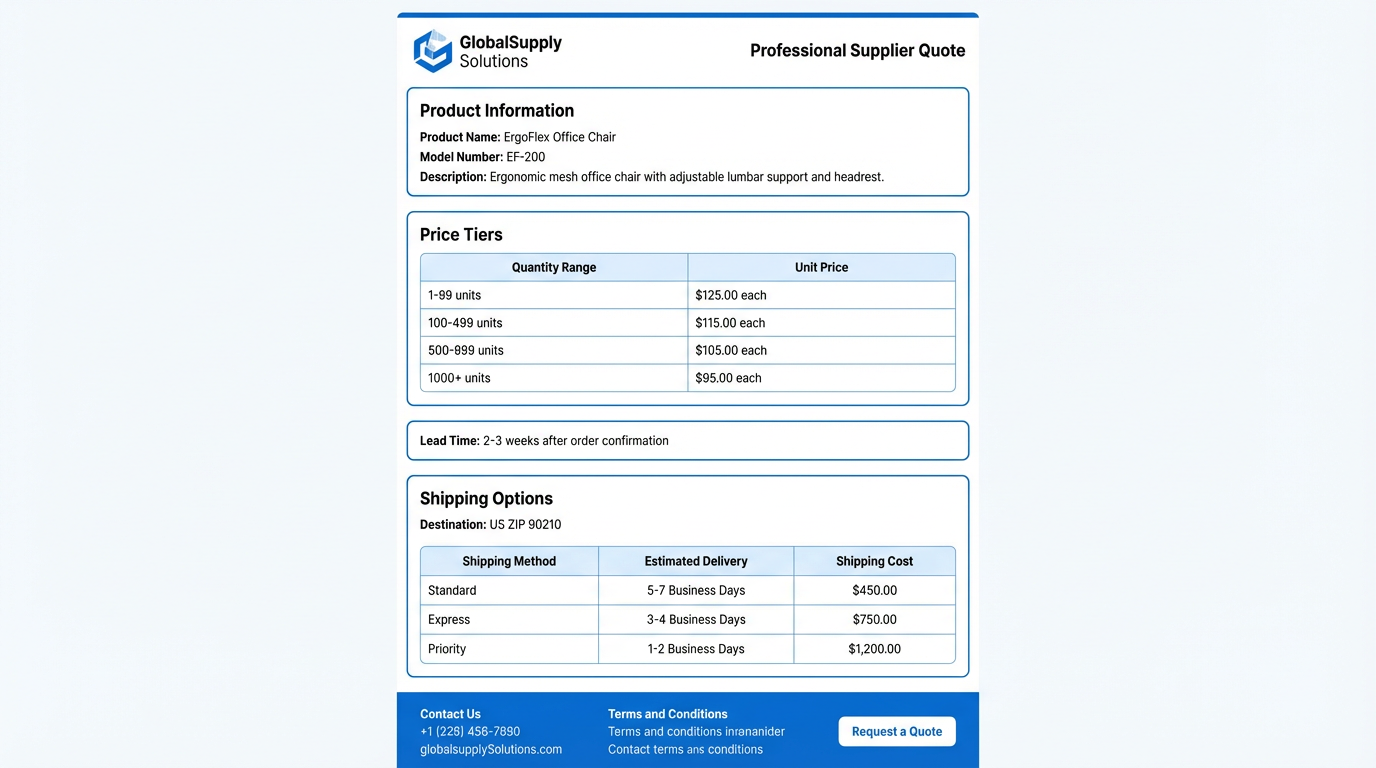
Certifications for EU and US markets
If you sell in the EU or US, start screening early for documentation readiness. Depending on category, you may need items like CE related documents, FCC related compliance, FDA related documentation, or material declarations. The goal is simple: identify suppliers who can support documentation when required.
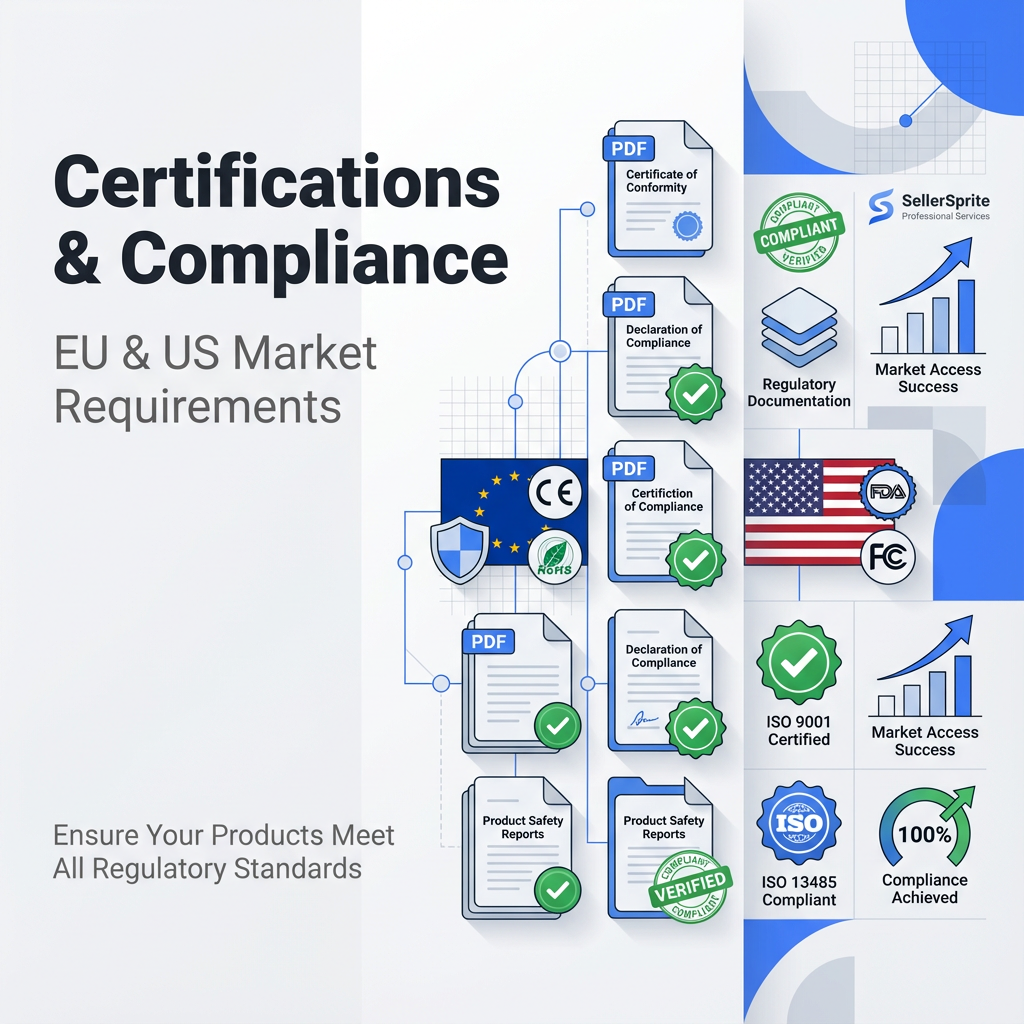
Next steps: samples, negotiation, long-term cooperation
Sample evaluation checklist
- Surface finish and material feel
- Fit and function (dimensions, tolerance, durability)
- Consistency across units (if you order multiple samples)
- Packaging quality and labeling accuracy
- Smell, stains, defects, and cosmetic issues
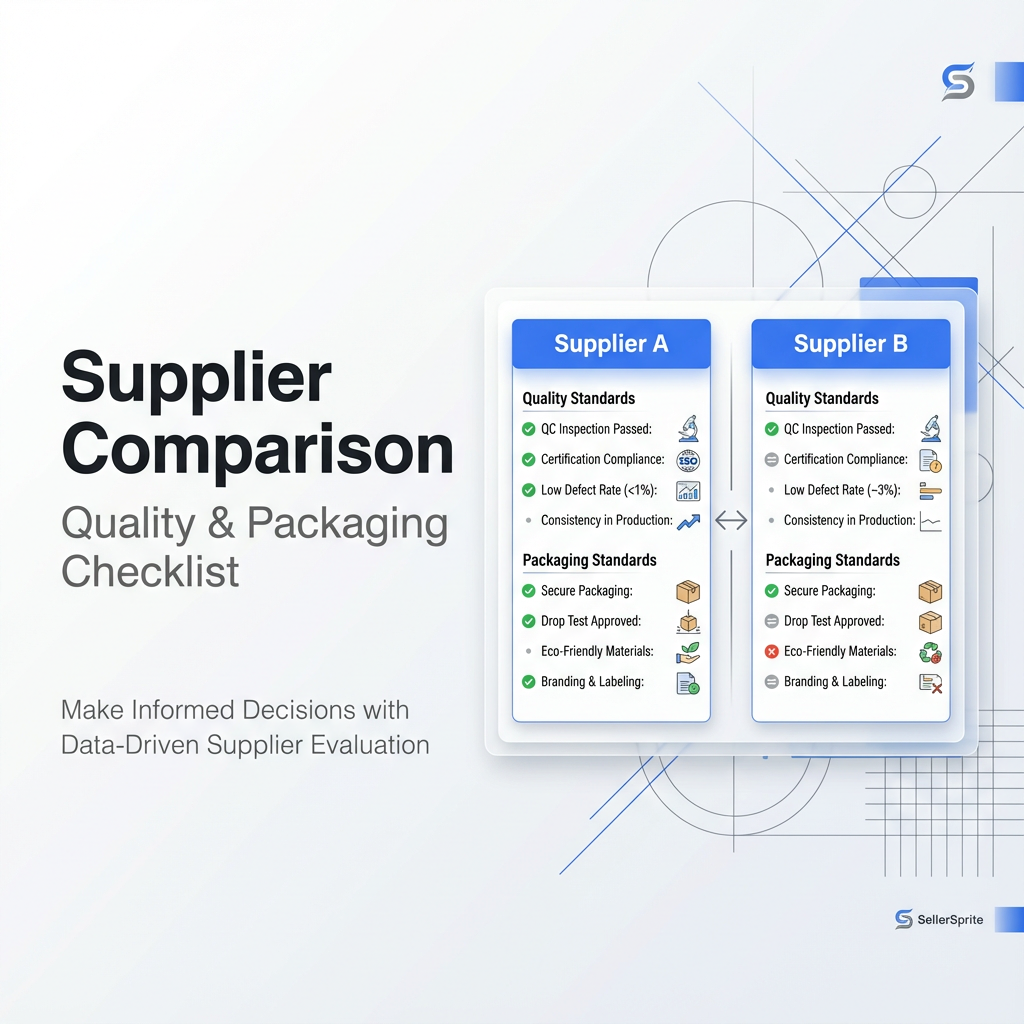
Negotiation order that avoids mistakes
- Confirm specs and quality standard in writing
- Confirm packaging, logo, and insert costs
- Confirm lead time and production plan
- Confirm price and payment terms
Common mistake
Negotiating price before specs are locked. If the specs change later, your price changes later too.
Protect the order with clear terms and platform tools
No matter how friendly the supplier is, protect yourself with clear written terms for quality and shipping timelines. If you use Alibaba tools like Trade Assurance, make sure the contract terms reflect what you agreed.
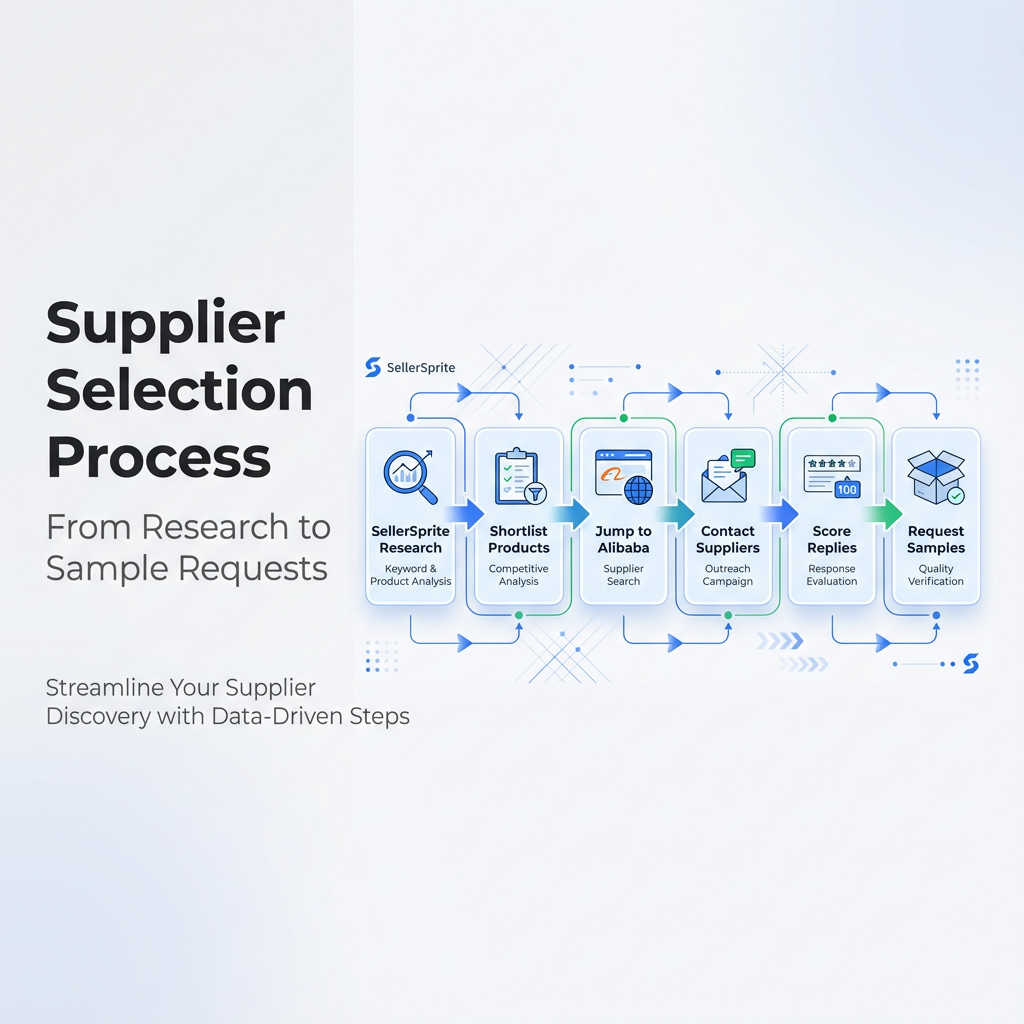
Research to supplier workflow with SellerSprite
From product validation to supplier outreach
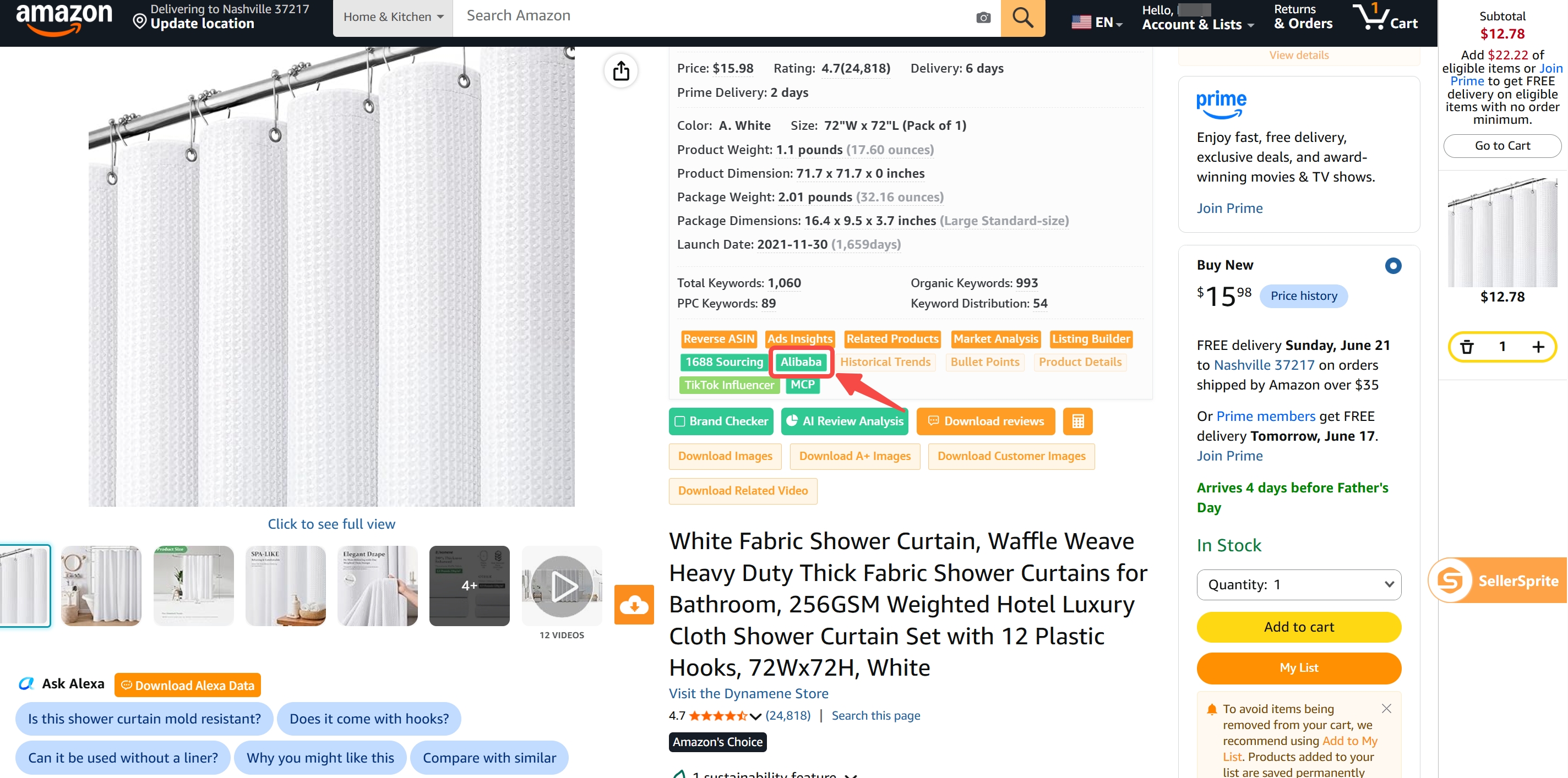
Run product research in SellerSprite, then use the built-in Alibaba sourcing shortcut to open similar listings fast. When you are ready, use the template above to contact suppliers and compare replies with the scoring sheet.
Run on Alibaba with SellerSprite
FAQ
How many suppliers should I contact on Alibaba?
A practical baseline is 10 to 30. If you contact fewer, you usually lose leverage and you have fewer comparable quotes.
Should I write a long message to sound professional?
No. Professional means clear. Keep it short, structured, and easy to answer. Use numbered questions.
Should I move the conversation to email or WeChat?
Many buyers do after the first response because it is faster for files and details. Start on Alibaba, then move channels if needed, while keeping clear written agreements.
What if suppliers do not answer my questions?
Treat it as a signal. Reply quality is part of supplier quality. Move on quickly and keep your pipeline full.
What is the fastest way to avoid scams?
Use clear terms, avoid off-platform payment pressure, and prefer protection mechanisms when available. Always validate details before paying.
About the author
SellerSprite Team. SellerSprite is an Amazon seller platform used by 1.6M+ registered sellers worldwide, with 700K+ browser extension installs, refined over 8+ years of product and workflow iteration. We publish step-by-step playbooks to help sellers move from product validation to supplier execution with fewer mistakes.