TL;DR: Understanding Amazon parent vs child ASINs isn't about catalog management; it's a competitive intelligence superpower. The real battle happens across variation families, not just single listings.
Key Takeaways
- Parent-child ASINs share reviews and trust but compete separately in keyword performance, which creates "review gravity" and conversion lift for top-performing child variations.
- Amazon's SERP often displays a specific child ASIN even when ranking the entire variation family, meaning visibility is not evenly distributed across children.
- To win against variation-heavy competitors, analyze child-specific keyword intent, track hero children, avoid internal cannibalization in PPC, and map clusters by use case or attribute.
Table of Contents
- The Real Reason "Parent vs. Child" Analysis Matters
- Parent vs. Child: What's Shared, What's Unique
- The Keyword Differences Are Usually Intent Differences
- Three Lenses to Analyze Competitor Variations
- Step-by-Step: How to Identify the "Hero Child"
- Reverse ASIN Pitfalls: Why Parent-Level Data Can Mislead
- Variation Ranking Patterns You Can Actually Learn From
- PPC Implications: Targeting Variations Without Burning Budget
- SEO Implications: Keyword Mapping When Variations Exist
- Red Flags: When Competitor Variations Are a Moat
- Mini Case Walkthrough Template
- FAQ
- References
Note on marketplaces: This guide is specifically optimized for the US market.
The Real Reason "Parent vs. Child" Analysis Matters (It's Not Just Catalog Hygiene)
Many sellers treat parent-child ASIN structures as an internal catalog task: something Amazon requires, not something strategic. But in 2026, the top-performing brands leverage variation families as competitive moats. The truth? You're not competing with a single ASIN; you're competing with a variation system designed to dominate search, boost conversions, and distribute traffic intelligently across child SKUs.
What is Parent ASIN & What is Child ASIN
Parent ASIN is the umbrella listing that groups variations (like size, color); Child ASIN is each individual variation that can have its own price, inventory, and image, but shares review history and brand trust with the parent.
The hidden advantage competitors get from variations: "review gravity" + conversion lift
Imagine launching a new black version of your product with zero reviews. Normally, that would kill conversion. But if it's part of a strong variation family with 4.7 stars and 1,200 reviews? Amazon applies what we call "review gravity," boosting the trust perception even for new or low-review children. According to an industry analysis, listings with 5+ child variations see up to 38% higher conversion rates on new SKUs than standalone new listings.
The seller takeaway: you're not competing with one listing; you're competing with a variation system
Your competitor isn't just selling one product; they're running a coordinated web of SKUs optimized for different intents, keywords, and buyer stages. Ignoring this variation ecosystem means missing where the real traffic and revenue go. Brands like Anker and Tile use this systematically to dominate niche categories by assigning specific roles to each child: traffic capture, monetization, or loss-leader positioning.
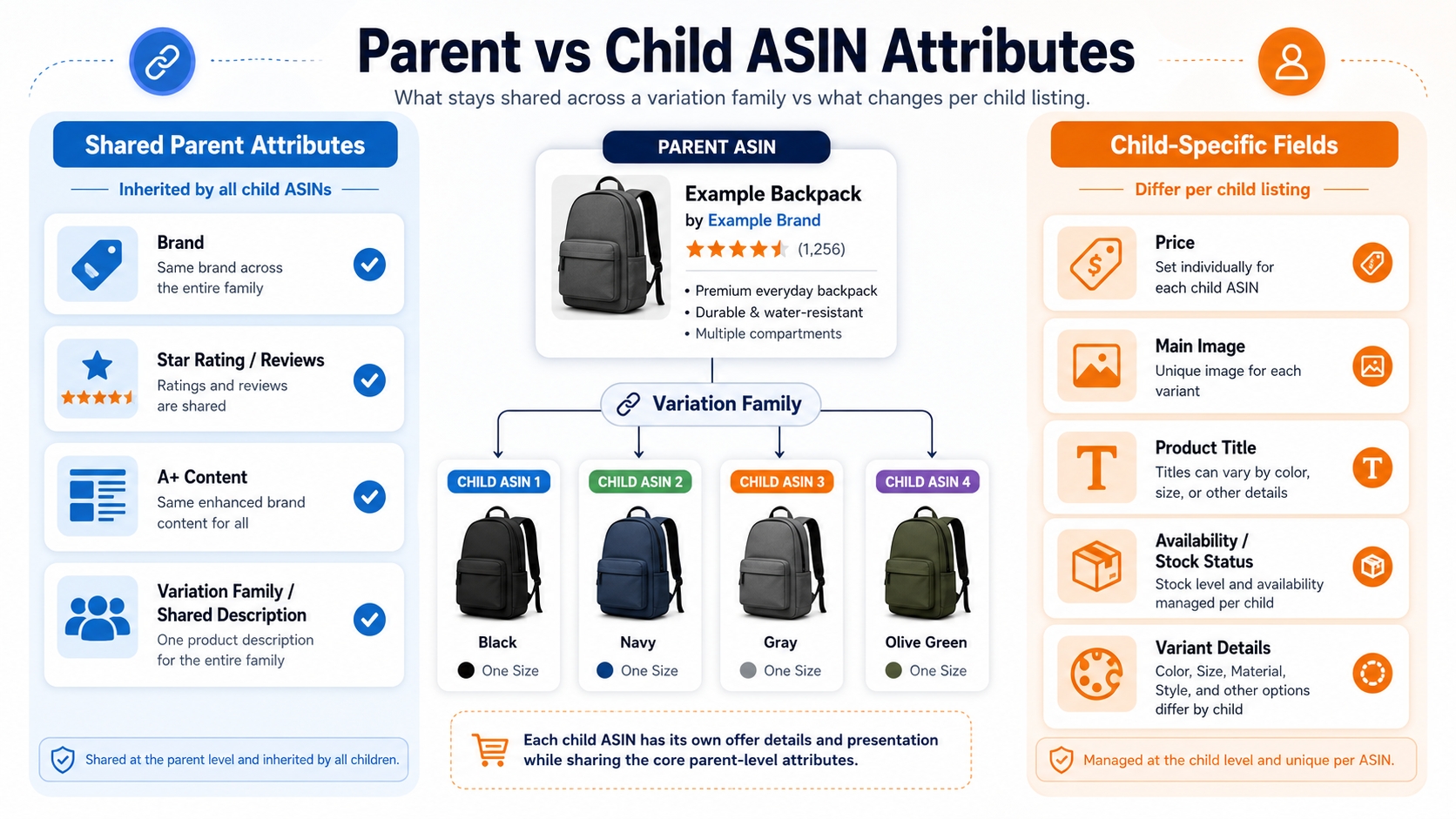
Parent vs. Child: What's Shared, What's Unique, and What Amazon Blends Together
To truly compete, you must understand how Amazon treats shared assets versus individual SKUs in rankings and visibility. The blend of shared and unique elements creates both opportunities and blind spots.
Shared assets: review count, star rating, A+ content (often)
The parent ASIN aggregates customer reviews and ratings across all children. This shared social proof strengthens the entire family's credibility. Additionally, A+ content (if applied at the parent level) appears across variations, ensuring consistent branding and feature storytelling. However, newer seller accounts may not always have this inherited down, especially if A+ is restricted.
Child-specific reality: price, availability, images, main title string, selected attributes
Each child ASIN has its own pricing, stock status, main image, and often a tailored title (e.g., "Blue - 64GB" vs. "Black - 128GB"). These differences matter because Amazon shows the child that best matches the user's keyword intent, not just the parent. For example, searching "large dog collar red" may surface the red XL child, even if the default parent shows blue medium.
The "blended SERP" problem: Amazon may rank the variation family, then display a child
Amazon frequently ranks the entire variation family but surfaces a specific child ASIN on the search results page (SERP). This creates confusion: your Reverse ASIN report might show the parent ranking, but in reality, only one or two children are capturing traffic. This is not a bug; it's an algorithmic optimization for relevance.
Why you must track which child shows for which keyword, not just "the ASIN ranks"
Rank tracking tools that only report at the parent level miss this critical detail. To win, you need granular visibility into which child appears for high-intent queries. SellerSprite's Keyword Tracker allows child-level SERP monitoring, revealing exactly which variation wins visibility for keywords like "waterproof hiking backpack 30L" vs. "50L". Without this, you're optimizing in the dark.
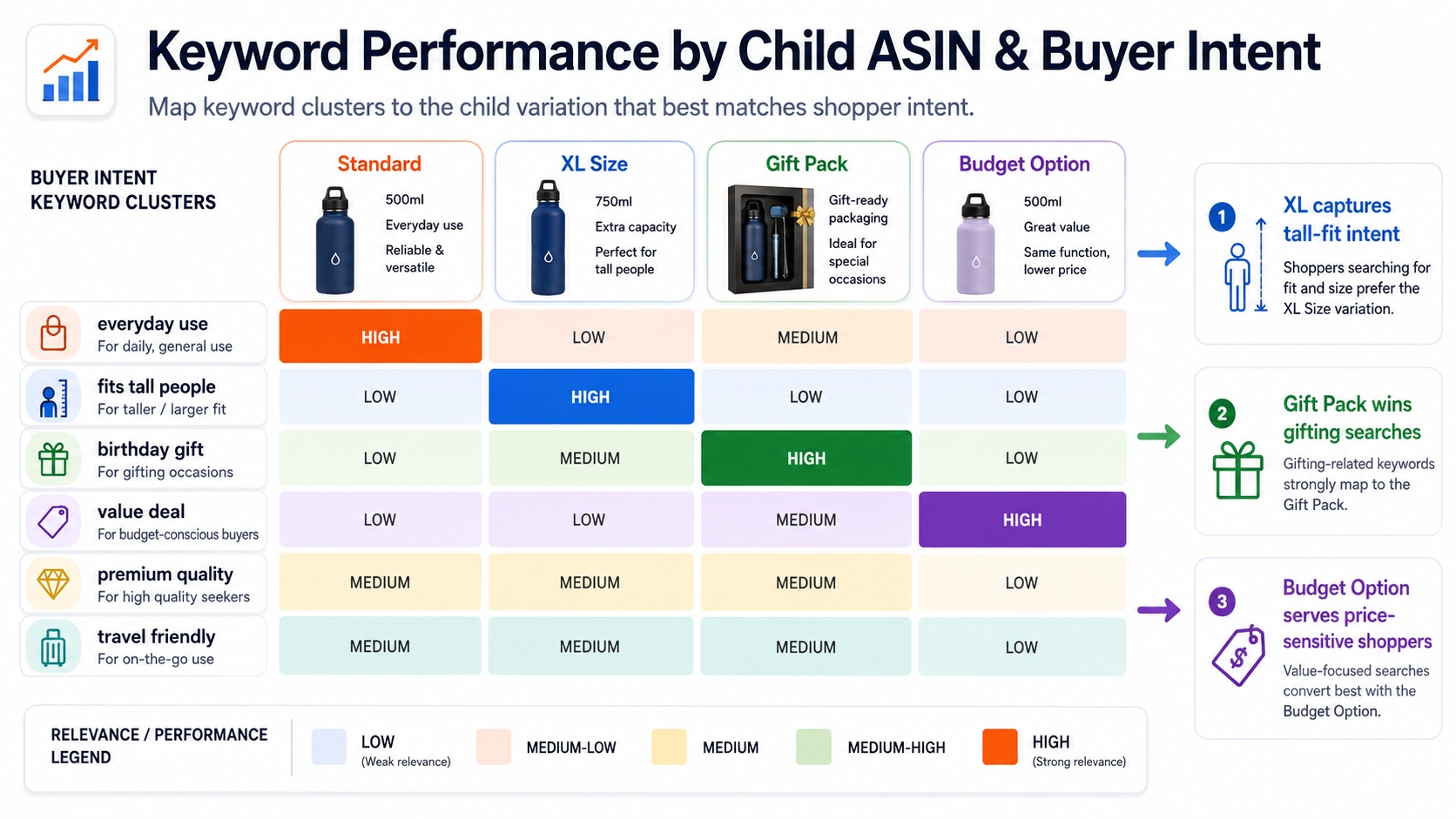
The Keyword Differences Are Usually Intent Differences (Not Word Differences)
Keyword variation isn't random. Each child attracts buyers with distinct motivations. Understanding these intent differences is key to replicating or outmaneuvering competitor strategies.
Variation intent: color/size/style changes what the buyer expects
A buyer searching for "white ceramic coffee mug" isn't just selecting a color; they're likely gifting, pairing with decor, or seeking a minimalist aesthetic. Meanwhile, "black travel coffee mug" implies portability, durability, and commute use. These subtle intent shifts mean the same product can serve multiple buyer journeys through variations.
Example patterns: "black" variants pull gift/fashion intent; "XL" pulls fit/compatibility intent
Data from SellerSprite's 2025 intent clustering engine shows consistent patterns: black and white variations dominate gift-related searches (27% higher CTR in Q4), while XL and XXL sizes rank strongly for "fits [device]" or "for tall people" queries. Recognizing these patterns helps you assign marketing roles to each child.
Attribute-led keywords: how variations capture modifier traffic (size, pack, material)
Variations inherently target long-tail modifier keywords. A six-pack of batteries captures "bulk AA batteries," while the single pack wins on "replacement AA battery." These are not synonyms; instead, they reflect different buyer needs: convenience vs. cost-efficiency. Competitors with well-structured variation themes often dominate these clusters organically.
Use-case-led keywords: why some children become "scenario winners" (travel, kids, outdoor)
Certain variations rise to the top not because of specs, but because they align with specific scenarios. A "compact" version of a blender may win searches for "personal blender for small kitchens," while the "large" version dominates "family smoothie maker." Scenarios drive intent, and variations should reflect them.
Intent → Variation Type Mapping
- Gift intent: White/black, gift pack, limited edition
- Fit/compatibility: XL, XXL, wide, tall, short
- Bulk/value: 6-pack, 12-pack, refill bundle
- Portability: Mini, travel, compact, foldable
- Special use: Kids, outdoor, car, gym
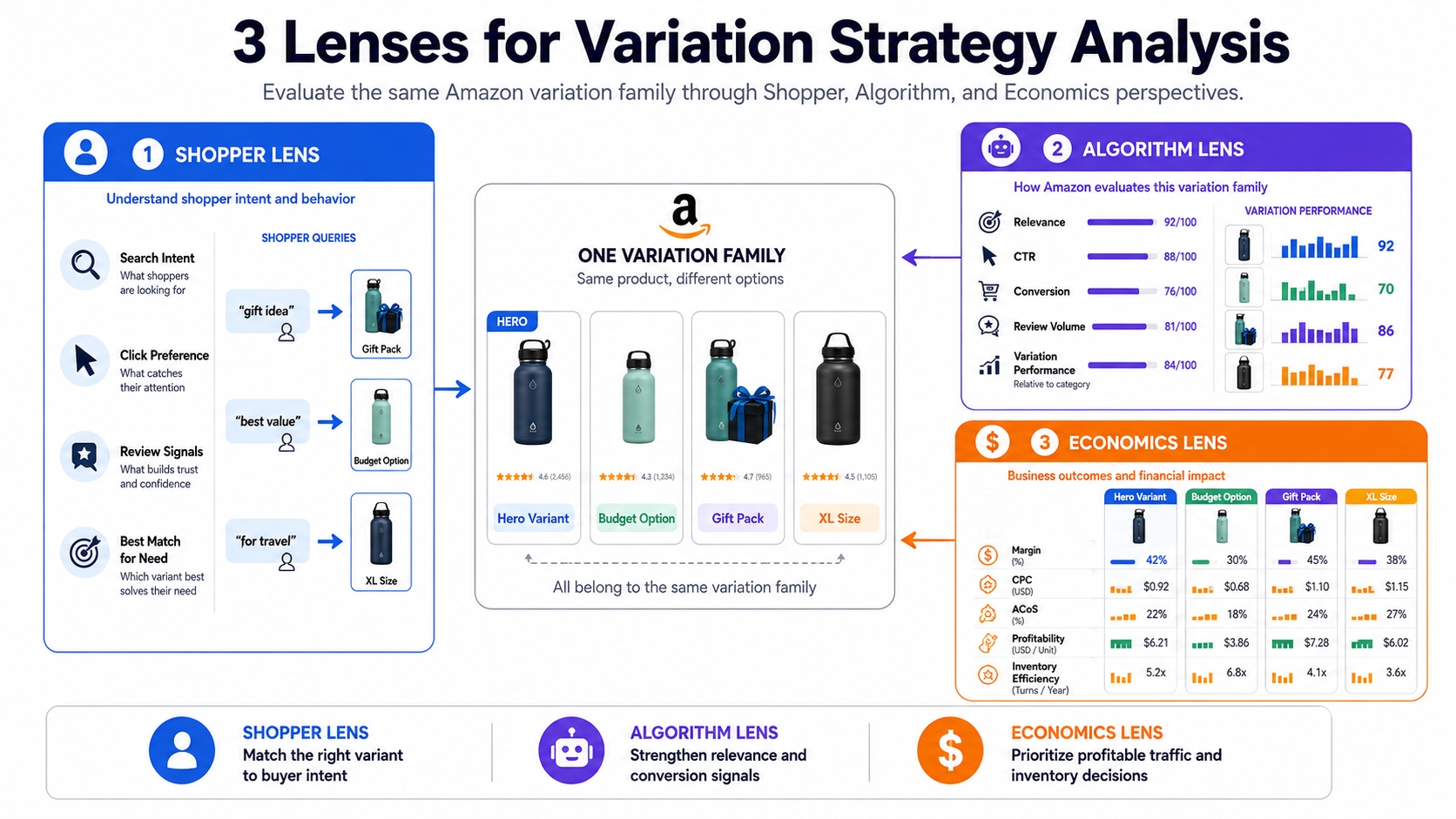
Three Lenses to Analyze Competitor Variations (A Non-Template Framework)
Instead of copying competitor layouts, use three analytical lenses to decode their variation strategy. This framework helps you reverse-engineer their logic, not just replicate it.
Lens #1 — Shopper lens: which variation is the "default choice" and why
Look for default selection bias (color/size preselected)
Go to the listing and see which option is selected by default. Is it black? Medium? 1-unit pack? This is often their *conversion hero*. They chose this default because it balances popularity, margin, and stock. For example, Southern Tide defaults to navy in polos, which indicates timeless, masculine, and high-margin, proving it's a deliberate choice, not random.
Lens #2 — Algorithm lens: how Amazon "inherits" trust across children
Review gravity: weak child rides strong family credibility
Amazon's algorithm favors variation families with strong aggregate reviews. A child with only 12 reviews can still convert at 18% if the family has 4.8 stars and 2K+ reviews. This "spillover trust" is critical. So, remember to check both parent and child review distribution and detect artificial gaps.
Lens #3 — Economics lens: which child is the profit engine vs. the traffic engine
Loss-leader children that win clicks, premium children that monetize
Some child ASINs are priced low to win the Buy Box or attract clicks, for example, think $19.99 3-pack of toothbrush heads. But the 6-pack at $34.99 has better margins and captures bulk buyers. The low-price child drives traffic; the high-tier child drives profit. Map pricing ladders across variations to reverse-engineer the profit architecture.
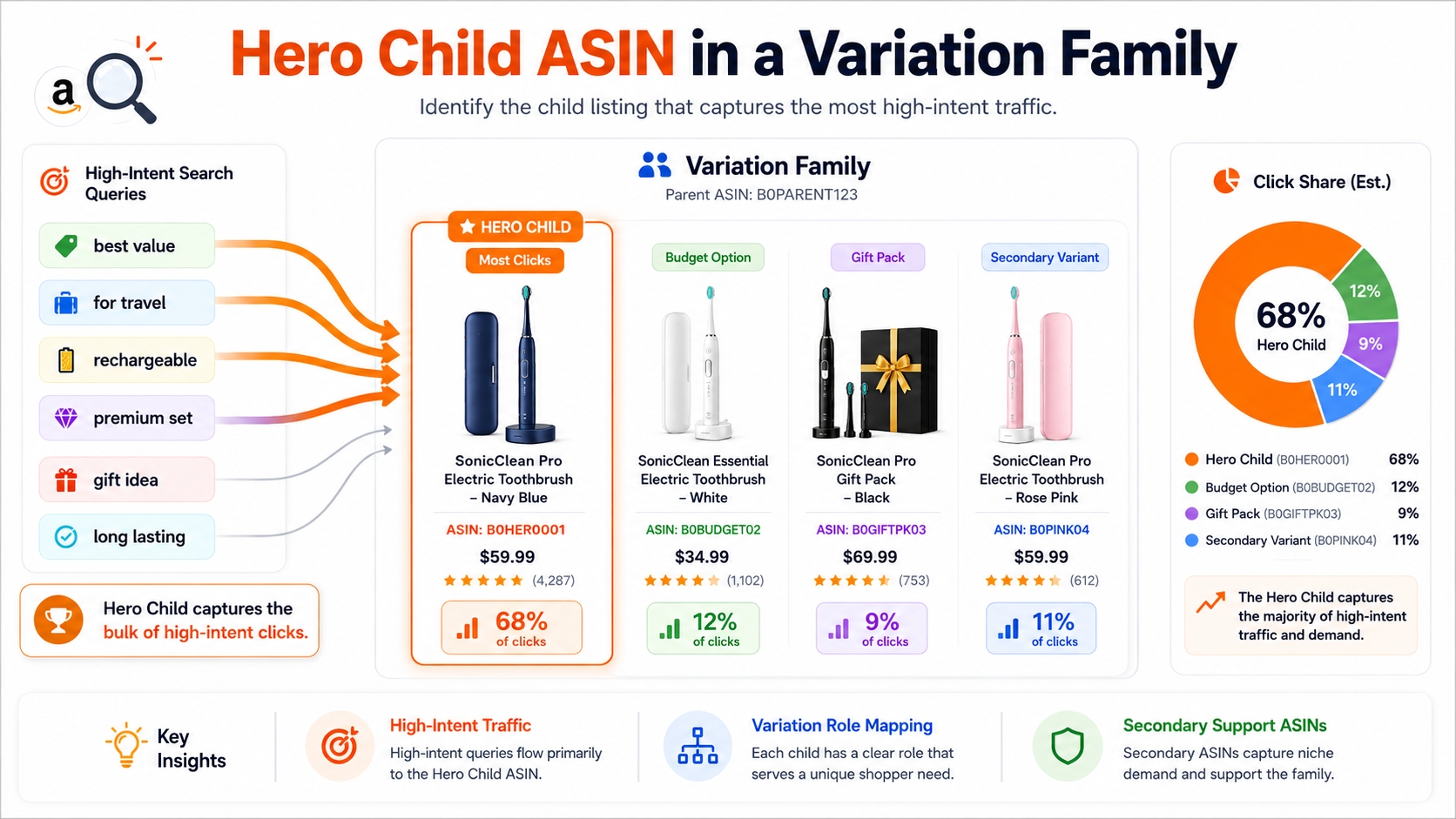
Step-by-Step: How to Identify the "Hero Child" (The One Doing the Heavy Lifting)
Most variation families have one "hero" child ASIN that captures the majority of high-intent traffic. Finding it gives you a shortcut to beating the listing.
Step 1: Map the variation grid (theme + options + price spread)
Record: variation theme, option count, price ladder, stock status
List out all variations. Note the theme (color, size, bundle), number of options, price range, and which are in stock. A cluttered grid with 15+ colors may signal confusion; a tight 3–5 option set often means strategic focus.
Step 2: SERP spot-check: which child appears for your top keywords?
Run 10–20 core keywords and note the displayed child each time
Manually search each keyword in incognito mode or use SellerSprite's free tool Index Checker to see which child ASIN appears on page 1. Track this across devices because mobile results sometimes differ.
Step 3: Detect "visibility concentration"
If one child appears disproportionately, that's likely the hero child
If the "black 64GB" version shows up for 14 of your 20 keywords, it's the hero. It's optimized for broad relevance. The others are support players. This insight tells you where to focus your competitive attack.
Step 4: Validate with ad clues (optional but powerful)
Sponsored placements often reveal which child is being pushed for which intent
Check Sponsored Products ads. Are they promoting a specific child? That's a sign of intentional targeting. Amazon only spends budget where it converts.
Step 5: Write your hypothesis: "Hero child = X because it matches Y intent + has Z offer edge"
Example: "Hero child = White 3-pack because it matches gift intent + has lowest price per unit among multi-packs." This becomes your strategic blueprint.
Hero Child ASIN Scorecard
- Display Rate: Appears in >70% of SERPs for core keywords
- Price Fit: Best value in its cluster (e.g., lowest $/unit)
- Stock Status: Consistently in stock (no buyability gaps)
- Review Leverage: Benefits from family's high aggregate rating
Reverse ASIN Pitfalls: Why Parent-Level Data Can Mislead You
Most reverse ASIN tools only analyze the parent, giving a false sense of competitiveness. But in reality, the action is at the child level.
"Reverse ASIN parent vs. child" issue: mixed signals from different children
One child ASIN might rank for "cheap," another for "premium," and Amazon aggregates this into one keyword profile for the parent. This masks where real demand lives. A parent might "rank for 5K keywords" but only one child converts on 80% of them.
Keyword diffusion: a family ranks broadly, but each child converts narrowly
The variation family acts as a broad net, but buyers convert only on specific configurations. Relying on parent-level keyword data leads to bloated, unfocused content and bidding.
What to do instead: run analysis for multiple child ASINs, then compare overlap
Use SellerSprite's Reverse ASIN to analyze top-performing child ASIN individually. Compare keyword overlap and search volume. The intersection reveals true demand clusters. Then, use Keyword Tracker to monitor child-specific SERP performance daily.
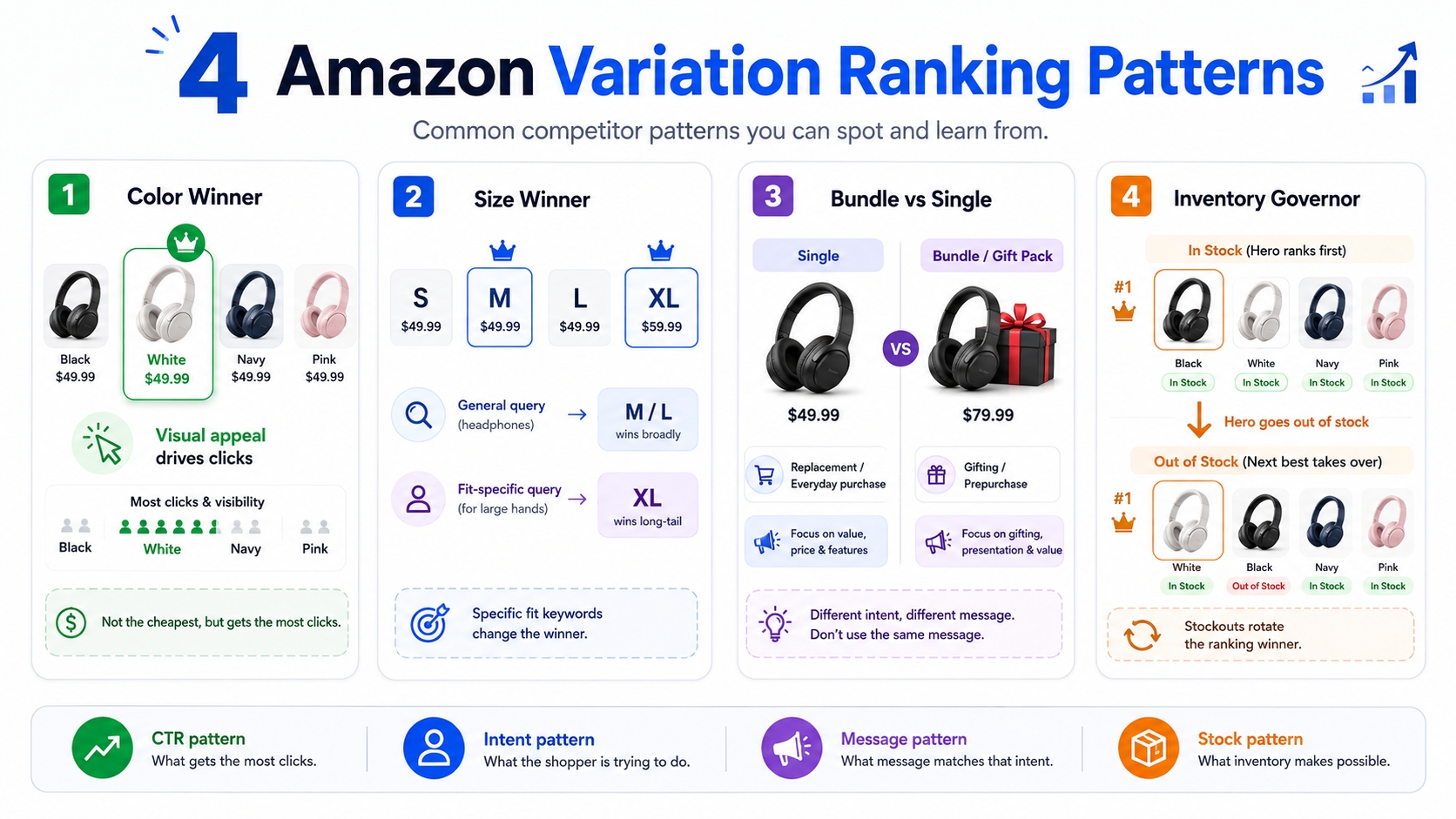
Variation Ranking Patterns You Can Actually Learn From
Top sellers follow repeatable patterns. Recognize them to predict behavior and find opportunities.
The "color winner" pattern (visual CTR dominates)
In apparel and home décor, one color, often black, white, or navy, consistently wins visibility due to visual appeal and broad compatibility. This child ASIN gets the most clicks even without being the cheapest.
The "size winner" pattern (fit/compatibility keywords dominate)
In tech accessories and clothing, the most common size (e.g., M, L, 64GB) dominates SERPs for general queries. For long-tail fit queries (e.g., "for large hands"), the XL version wins. Size = specificity.
The "bundle vs. single" pattern (different intent clusters; should not share one message)
Single units attract replacement buyers; bundles attract prepurchasers or gifters. They require different messaging. Competitors who use the same copy for both lose relevance.
The "inventory governor" pattern (stockouts silently rotate which child ranks)
When the hero child goes out of stock, Amazon promotes the next best child. This can distort performance data. Monitor stock status to avoid misreading trends.
PPC Implications: Targeting Variations Without Burning Budget
Your ad strategy must mirror the variation logic, or risk internal competition and wasted spend.
When to advertise the hero child vs. spread across child ASINs
Focus budget on the hero child for broad and high-intent keywords. Use other children only for highly specific modifiers (e.g., "gift pack" or "XXL") where they uniquely satisfy demand.
Variation-level targeting strategy
Run product ads targeting your competitor's hero child ASIN, not just the parent. This captures buyers at their point of intent. Use negative targeting to prevent your own child ASIN from competing.
Prevent internal cannibalization (your campaigns fighting each other)
For each keyword cluster (e.g., "gift coffee mug"), assign one child ASIN to "own" it. Disable bids on other child ASINs for those terms. This preserves ACoS and clarifies performance attribution.
SEO Implications: Keyword Mapping When Variations Exist
Optimizing both at the parent and child levels ensures maximum long-tail capture without dilution.
Parent-level copy vs. child-level copy: where differentiation belongs
Keep shared bullets benefit-led; use child titles for precise modifiers
Parent-level bullets should focus on universal benefits ("leak-proof design," "easy to clean"). Child titles include modifiers ("Travel Size," "6-Pack"). This avoids redundancy and boosts keyword relevance.
Avoid “keyword flattening”
Never duplicate the same bullet points across child ASINs. Tailor copy to reflect the variation's unique value. "Compact size fits in purses" only belongs on the mini version.
Build “variation-specific clusters”
Create separate SEO clusters: "travel mugs" → mini child; "gift mugs" → gift pack; "large mugs" → tall version. This aligns content with search intent and improves organic ranking precision.
Red Flags: When Competitor Variations Are a Moat (And When They're a Mess)
Not all variation families are equal. Some signal strength; others reveal vulnerability.
Moat signals
A clear hero child, coherent price ladder, consistent review leverage
This competitor is strategic. They know their hero and are optimizing it. Best response: niche down or differentiate on use case.
Mess signals (your opportunity)
Too many options, unclear default, mismatched images, scattered intent coverage
This is disorganization. They're confusing buyers. Attack with a cleaner, more focused variation strategy and precise copy.
Your strategic move: attack the gap they can't cover well (single-minded offer)
If they're bloated, be focused. If they're generic, be specific. Win on clarity.
Mini Case Walkthrough Template (So Readers Can Repeat It Fast)
Apply the framework in under 30 minutes.
Pick 3 competitor variation families
Choose leaders in your niche with mature variation structures.
Identify hero child + 2 "support" child ASINs
Use SERP checks and pricing analysis to classify roles.
Extract child-specific keyword clusters
Run each child through Reverse ASIN to find distinct keyword sets.
Turn insights into your plan: listing map + PPC focus + variation design choices
Build your optimized variation strategy with clear roles, messaging, and campaign targeting.
FAQ
How does the parent-child ASIN structure affect product visibility and sales on Amazon?
The parent-child structure boosts visibility through shared review counts and social proof, increasing overall trust and click-through rates. However, individual child ASINs can perform very differently based on their alignment with keyword intent, pricing, and stock status. One child often dominates SERP appearances, capturing the majority of traffic and sales, while others play supporting roles.
Why does a different variation show on the SERP than the one I clicked?
Amazon's algorithm selects the most relevant child ASIN based on the user's search query. Even if you click on the parent listing, Amazon may default to the variation that best matches recent search intent (e.g., "red dress size 10"). This improves buyer experience but requires sellers to optimize each child for specific keywords.
Do variations share keyword indexing?
Partially. While the parent ASIN may rank for broad terms, individual child ASINs often index for specific attribute-based keywords (e.g., color, size, bundle). Amazon uses a blend of family-level authority and child-level relevance to determine SERP placement. Optimizing child titles and images for modifiers improves indexing for long-tail queries.
When should I separate a parent-child listing into individual listings for better ranking?
Consider separating only if variations serve completely different audiences, intents, or use cases (e.g., a phone case and a screen protector). Otherwise, you lose shared review benefits. However, if one child gains enough traction and differentiation, splitting it later can allow dedicated SEO and PPC focus.
Next Steps
- Use SellerSprite's Reverse ASIN Tool to analyze a top competitor's variation family and identify their hero child.
- Read our Reverse ASIN Strategy Guide to master full-funnel competitive research.
References
By SellerSprite Success Team
The SellerSprite Success Team combines 10+ years of Amazon marketplace expertise with proprietary AI-driven analytics. We've helped thousands of brands optimize listings, reverse-engineer competitors, and scale profitably on Amazon using data-first strategies validated in the real marketplace conditions.