Revenue can make an Amazon business look healthy. ROI tells you whether that business is actually profitable. This guide explains how to calculate Amazon FBA return on investment, which costs to include, and how to use ROI to make better product, pricing, and advertising decisions.
Key Takeaways
- Track every cost, not only product cost. Include COGS, referral fees, FBA fulfillment, storage, prep, inbound shipping, advertising, returns, and refunds.
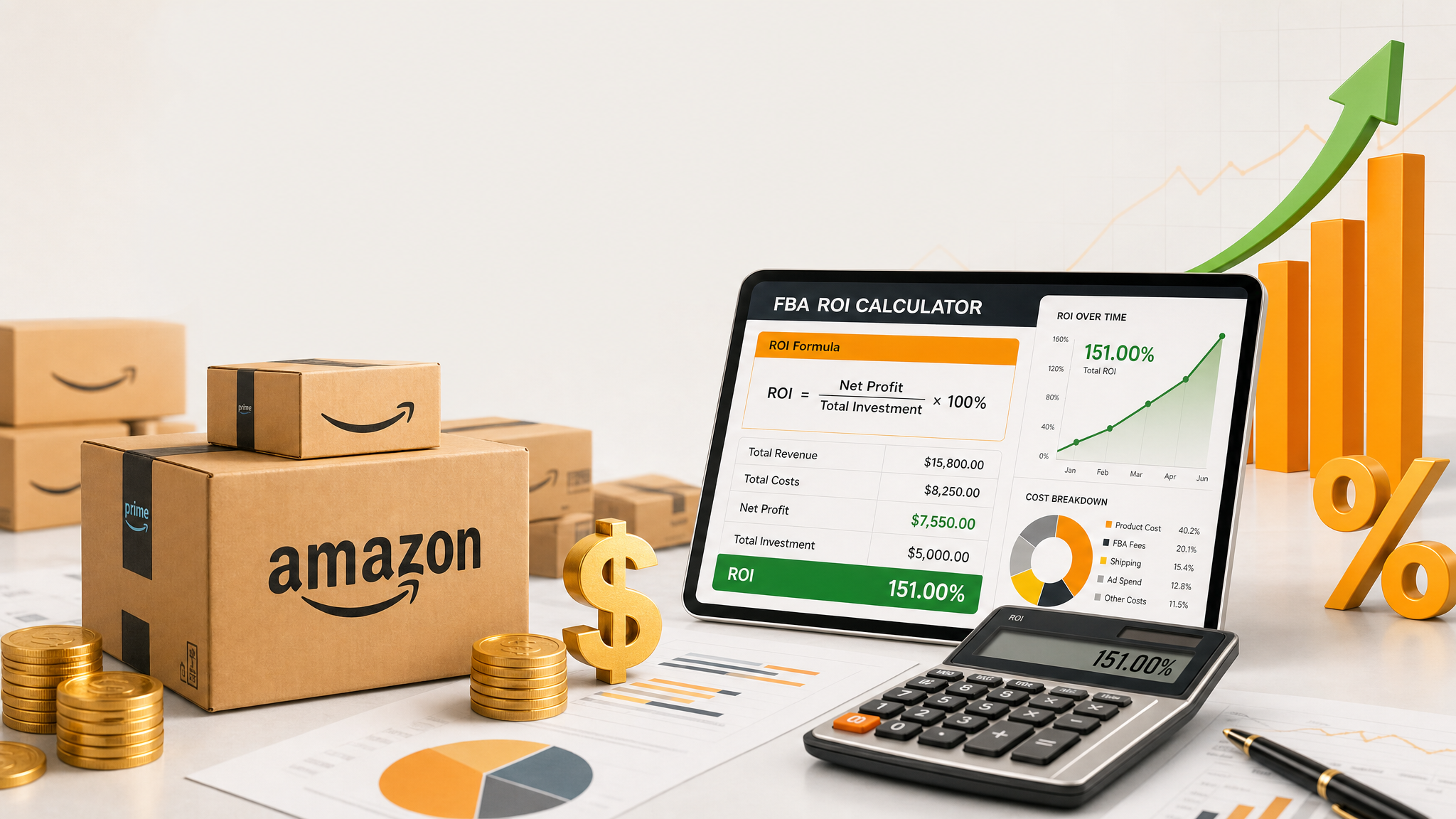
- Use the complete ROI formula. ROI = (Net Profit ÷ Total Investment) × 100.
- Do not confuse sales with profit. A high-revenue SKU can still lose money if fees and ad spend are not controlled.
- Use profit margin and ROI together. ROI measures how efficiently capital turns into profit. Profit margin shows how much you keep from each sale.
- Validate ROI before you reorder inventory. A SKU should support healthy replenishment, ads, and price pressure before you scale it.
What Is Amazon FBA ROI?
Amazon FBA ROI measures how efficiently your investment turns into profit. In practical terms, it answers one question: for every dollar you put into a product, how much profit comes back after all Amazon-related costs?
For Amazon sellers, ROI should include the full investment required to launch or replenish a SKU. That means product cost, freight, prep, Amazon fees, advertising, and returns. If you calculate ROI using only the factory cost, the result will look better than reality and may lead to poor reorder decisions.
Quick Definition
Amazon FBA ROI is the percentage return generated from your total investment in an FBA product after deducting all costs required to sell that product.
Why ROI Matters More Than Sales Revenue
Sales revenue shows how much money came in. ROI shows whether your business model works. A seller can generate impressive monthly sales and still lose money if Amazon fees, storage, PPC, returns, and replenishment costs exceed profit.
For example, a product with strong daily sales may look attractive at first glance. But if the category has high referral fees, heavy fulfillment costs, rising CPCs, and a high return rate, the SKU may tie up cash without producing meaningful returns.
| Metric | What It Shows | Why It Matters |
|---|---|---|
| Sales Revenue | Total money collected from customers | Useful for measuring demand, but not profitability |
| Net Profit | Money left after all costs | Shows whether the SKU actually earns money |
| ROI | Profit generated from invested capital | Helps decide whether to reorder, scale ads, or exit |
| Profit Margin | Net profit as a percentage of sale price | Shows how much of each sale you keep |
Amazon FBA ROI Formula
The basic formula is simple:
ROI = (Net Profit ÷ Total Investment) × 100
Where:
- Net Profit = Sale price - Amazon fees - product cost - shipping - advertising - storage - returns - other direct costs
- Total Investment = Product cost + shipping + prep + any cost required to make the inventory available for sale
You should also calculate profit margin:
Profit Margin = (Net Profit ÷ Sale Price) × 100
ROI and margin are different. ROI tells you whether your capital is working efficiently. Margin tells you how much cushion you have inside each sale.
Amazon FBA Cost Breakdown: What to Include
An accurate ROI calculation depends on complete cost tracking. Below is a practical cost checklist for Amazon FBA sellers.
| Cost Type | What to Include | Common Mistake |
|---|---|---|
| COGS | Unit product cost, packaging, supplier charges, and landed cost | Using only factory price instead of landed cost |
| Amazon referral fee | Category-based commission charged on each sale | Forgetting that fee rates vary by category |
| FBA fulfillment fee | Pick, pack, and ship fee based on size and weight | Ignoring size tier impact before product design is final |
| Storage fees | Monthly storage, peak season storage, and aged inventory risk | Over-ordering seasonal or slow-moving products |
| Shipping and prep | International freight, domestic trucking, labeling, polybags, inspection, prep center fees | Leaving prep and inbound costs outside ROI |
| Advertising | Sponsored Products, Sponsored Brands, Sponsored Display, launch PPC, and test budgets | Judging ROI before ad spend stabilizes |
| Returns and refunds | Refund administration, return processing, damaged inventory, resellability loss | Assuming every returned unit can be resold at full value |
| Software and overhead | Research tools, accounting, design, photography, and allocated business costs | Ignoring recurring costs when scaling many SKUs |
How to Calculate Amazon FBA ROI Step by Step
Step 1: Start with the real selling price
Use the actual average selling price after coupons, discounts, and promotions. If your product sells for $29.99 but you usually run a $3 coupon, use the effective selling price instead of the list price.
Step 2: Calculate Amazon fees
Add the referral fee, FBA fulfillment fee, storage allocation, and any other Amazon charges that apply to the SKU. Fees vary by category, size tier, and inventory behavior, so do not reuse assumptions from another product without checking.
Step 3: Add product and logistics costs
Include the product unit cost, packaging, inspection, freight, customs, domestic delivery, prep, labeling, and inbound placement or receiving-related costs. This is where many ROI calculations become too optimistic.
Step 4: Add advertising cost per unit
If ads are required to generate sales, include advertising as a cost. You can estimate ad cost per unit by dividing total ad spend by attributed units sold, or by modeling target ACoS when planning a new product.
Step 5: Estimate return and refund cost
Every category has different return behavior. Apparel, electronics, and size-sensitive items need special attention. Estimate the average return cost per unit sold, not only the cost per returned unit.
Step 6: Calculate net profit
Subtract all costs from the sale price. This gives you net profit per unit.
Step 7: Apply ROI and profit margin formulas
Use ROI to evaluate capital efficiency and profit margin to evaluate per-sale health. A product with decent margin but slow inventory turnover may still create cash flow pressure.
Example Amazon FBA ROI Calculation
Here is a simplified example for one unit sold through FBA.
| Line Item | Amount |
|---|---|
| Sale price | $39.99 |
| Product landed cost | $10.50 |
| Amazon referral fee | $6.00 |
| FBA fulfillment fee | $5.20 |
| Storage and prep allocation | $1.10 |
| PPC cost per unit | $4.00 |
| Return cost allocation | $1.20 |
| Total cost | $28.00 |
| Net profit | $11.99 |
ROI = ($11.99 ÷ $10.50) × 100 = 114.2%
Profit Margin = ($11.99 ÷ $39.99) × 100 = 30.0%
This example looks healthy because the net profit is strong relative to the landed cost. However, the seller should still monitor ad cost, storage, return rate, and price pressure over time.
Tools and Methods for Tracking ROI
Manual spreadsheets
Spreadsheets work well for beginners with a small SKU count. They help you understand the math and force you to define every cost input. The limitation is that manual files become hard to maintain as SKU count, promotions, and ad campaigns grow.
Amazon calculators
Amazon calculators can help estimate fulfillment-related fees and compare fulfillment models. They are useful during early planning, but sellers should verify assumptions with their own landed cost, ad cost, and return data.
SellerSprite profitability planning
Before investing in inventory, use the SellerSprite Profitability Calculator to model product cost, Amazon fees, shipping, and estimated profit. Pair profitability planning with SellerSprite Keyword Research and Reverse ASIN to confirm that a product has enough demand and realistic traffic opportunities before you scale.
Automated profit tracking software
As your catalog grows, automated profit dashboards become more useful. They can help monitor SKU-level profit, ad cost, refunds, and inventory movement in near real time.
How to Improve Amazon FBA ROI
Once you calculate ROI, the next step is improvement. Start with the levers that have the largest impact on net profit.
| ROI Lever | What to Improve | How to Measure It |
|---|---|---|
| Product cost | Negotiate better MOQ, packaging, or material choices without hurting quality | Unit landed cost and defect rate |
| Pricing | Test price bands that protect conversion and margin | Unit session percentage, Buy Box, net profit per unit |
| Advertising | Shift spend from broad waste to high-intent keywords and converting ASIN targets | ACoS, TACoS, CPC, conversion rate |
| Listing conversion | Improve title, images, bullets, A+ content, reviews, and Q&A | CTR, conversion rate, sales rank, organic keyword rank |
| Returns | Reduce sizing confusion, quality issues, damaged delivery, and expectation gaps | Return rate, refund reason, review sentiment |
| Inventory velocity | Avoid over-ordering and long-term storage exposure | Sell-through rate, days of inventory, storage cost |
For product research and launch planning, ROI should be reviewed alongside demand, keyword difficulty, competitive concentration, and review barriers. A product with strong theoretical ROI may still be risky if the niche requires expensive ads or a large review base before conversion improves.
Common Amazon FBA ROI Mistakes
- Using revenue as proof of success. Revenue can hide weak margins.
- Ignoring PPC during product validation. If paid traffic is required, ad cost belongs in the model.
- Underestimating returns. Return-heavy categories need return cost allocation from day one.
- Forgetting storage and aged inventory risk. Slow-moving inventory can reduce or erase ROI.
- Not updating assumptions. Fees, CPCs, conversion rates, and competitor pricing can change over time.
Plan ROI Before You Invest in Inventory
SellerSprite helps Amazon sellers connect product research, keyword demand, competitor analysis, and profitability modeling before committing to inventory. Use data to decide whether a product is worth launching, how much margin it can support, and where traffic opportunities exist.
FAQs
Q1. What is the basic formula for calculating Amazon FBA ROI?
Amazon FBA ROI = (Net Profit ÷ Total Investment) × 100. Net profit is your sale price minus Amazon fees, product cost, shipping, advertising, storage, returns, and other operating costs.
Q2. What is a good ROI for Amazon FBA sellers?
Many sellers use 100% ROI as an ideal benchmark because it means the investment is doubled. A lower but still workable range depends on the category, competition, cash flow, and replenishment strategy.
Q3. Which costs should be included in Amazon FBA ROI?
Include product cost, landed shipping cost, customs, Amazon referral fee, FBA fulfillment fee, storage, prep, inbound placement, advertising, returns, refunds, and any software or overhead allocated to the SKU.
Q4. Why is ROI more useful than revenue?
Revenue only shows sales volume. ROI shows whether the money invested into inventory and launch activities is producing real profit after costs.
Q5. How can SellerSprite help with Amazon FBA ROI planning?
SellerSprite can help estimate demand, review keyword and competitor data, and model profitability before placing an inventory order, helping sellers avoid products that look attractive but have weak margins.